GATE EC Control Systems Previous Year Questions with Solutions
20 Control Systems questions from the GATE EC 2026 and 2025 and 2024 and 2023 papers, newest first. Try each one, then open its answer: the official answer from that year's key and a worked solution. Each question links to its place in the full paper.
GATE 2026, Q.19
Control Systems1 markMCQ
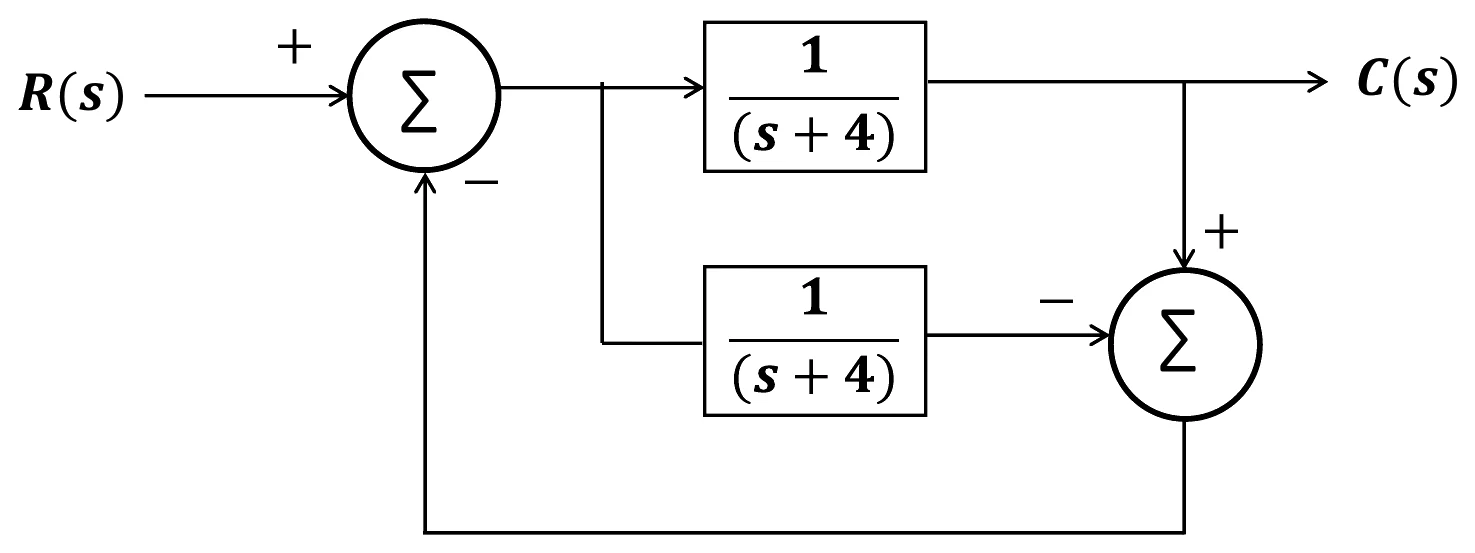
An error signal feeds two identical blocks; the output is taken from one, and the feedback is the difference of the two outputs. Find .
Full question on page 19 of the official paper (PDF)
Show answerHide answer
Key idea: Two identical blocks driven by the same signal give identical outputs, so the feedback is zero.
Official answer: B
Call the error signal E. Both blocks see E, so their outputs are equal, E/(s+4). The feedback is their difference, which is zero:
Option (B).
GATE 2026, Q.40
Control Systems2 marksMCQ
Unity negative feedback is applied around , with and . Which puts the closed-loop poles at ?

Full question on page 37 of the official paper (PDF)
Show answerHide answer
Key idea: Match the characteristic polynomial to the one the target poles give.
Official answer: B
The closed-loop characteristic equation is 1 + C(s)G(s) = 0:
The required poles give
(s + 3)^2 + 5 = s^2 + 6s + 14Matching coefficients: 3 + K = 6, so K = 3; and 2 + 3\alpha = 14, so \alpha = 4. Option (B).
Learn the idea:
GATE 2026, Q.41
Control Systems2 marksMCQ
Find for and .
Full question on page 38 of the official paper (PDF)
Show answerHide answer
Key idea: The transfer function is C(sI - A)^{-1}B.
Official answer: C
Option (C).
Learn the idea:
GATE 2026, Q.59
Control Systems2 marksNAT
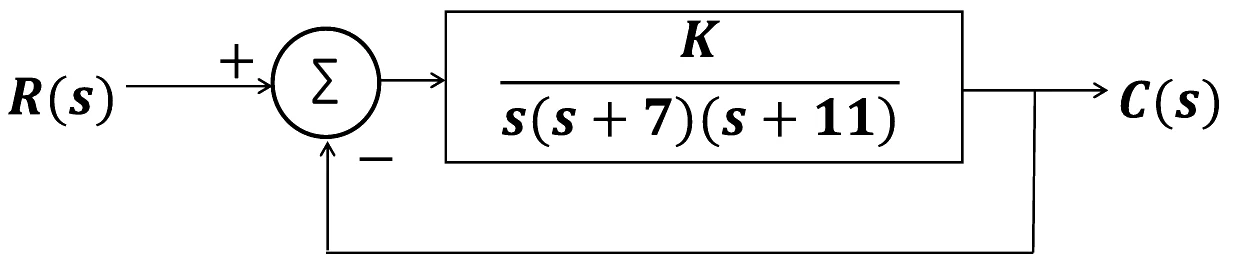
Unity negative feedback is applied around . Find the gain at which the system is marginally stable.
Answer format: Integer
Full question on page 56 of the official paper (PDF)
Show answerHide answer
Key idea: For s^3 + as^2 + bs + K, the Routh array hits the stability edge at K = ab.
Official answer: 1386
The characteristic equation is
For a cubic s^3 + a s^2 + b s + c, the Routh array's s^1 row is (ab - c)/a. It reaches zero, the edge of stability, when
K = 18 \times 77 = 1386At that gain the auxiliary equation 18s^2 + 1386 = 0 gives poles at s = \pm j\sqrt{77} \approx \pm j8.77 rad/s, on the imaginary axis. K = 1386.
Learn the idea:
GATE 2025, Q.16
Control Systems1 markMCQ
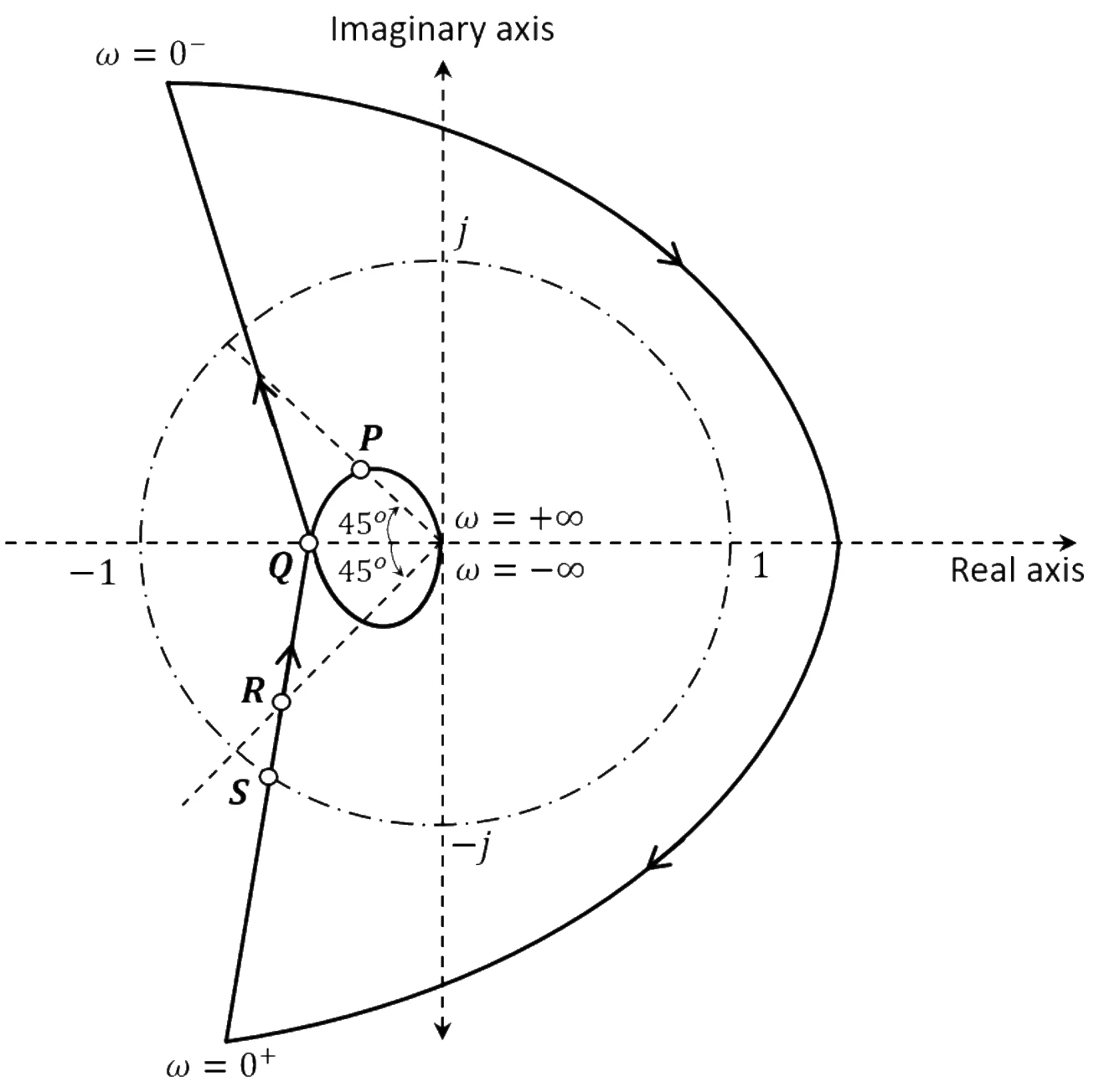
The figure shows a Nyquist plot with the unit circle dashed. , , and are the positive frequencies at the points P, Q, R and S. Which statement is TRUE?
Full question on page 15 of the official paper (PDF)
Show answerHide answer
Key idea: Gain crossover is where the plot meets the unit circle; phase crossover is where it meets the negative real axis.
Official answer: D
At the gain crossover frequency |G(j\omega)H(j\omega)| = 1, so the plot is on the unit circle. Of the four points, only S lies on the dashed unit circle.
At the phase crossover frequency the phase is -180°, so the plot is on the negative real axis. That is Q, where the branch crosses the axis inside the circle.
P and R are marked where the plot meets the 45° lines through the origin; they are neither crossover. So \omega_S is the gain crossover and \omega_Q the phase crossover. Option (D).
Learn the idea:
GATE 2025, Q.26
Control Systems1 markMSQ
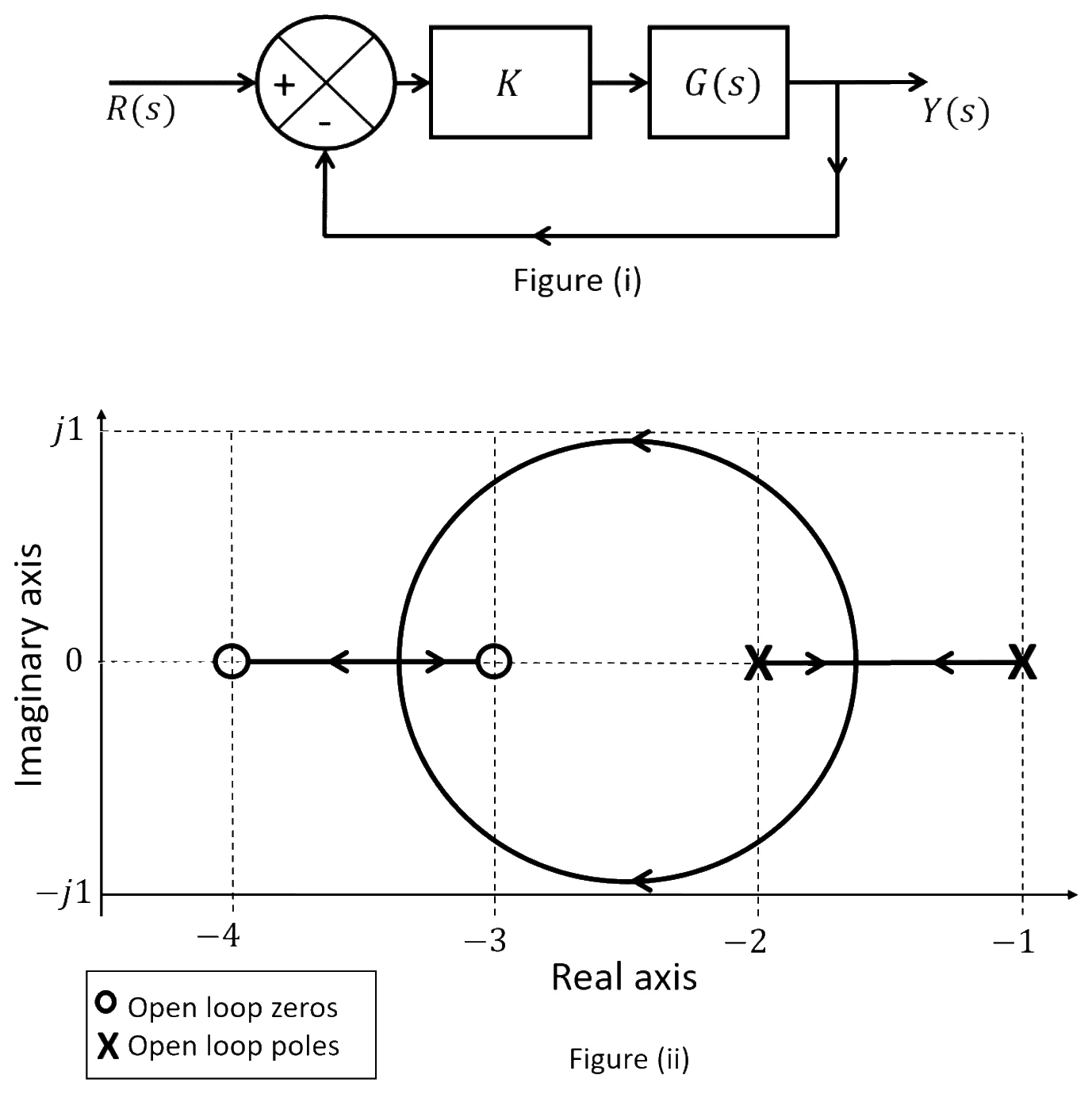
The unity negative-feedback system in the figure has gain in front of . Its root locus, also shown, has open-loop poles at and and zeros at and . For what value or values of does the closed loop have a pole at ?
One or more options are correct.
Full question on page 25 of the official paper (PDF)
Show answerHide answer
Key idea: A point is a closed-loop pole for some K > 0 only if it lies on the root locus, which the angle condition decides.
Official answer: C
From the figure, G(s) = \dfrac{(s+3)(s+4)}{(s+1)(s+2)} up to a positive constant. At s = -1 + j, the angle of G is
A point on the root locus needs \pm 180°, so -1 + j is not on it. Solving for K directly confirms it:
That isn't a real number, so no K works. The figure agrees: the circle only reaches about \pm j0.87. Option (C). Option (B) is the size of that complex value, 0.2, taken as if it were a gain.
GATE 2025, Q.36
Control Systems2 marksMCQ
is controlled by in a unity negative-feedback loop, as in the figure. (i) No controller with makes the closed loop stable. (ii) At least one controller with makes it stable. Which is correct?
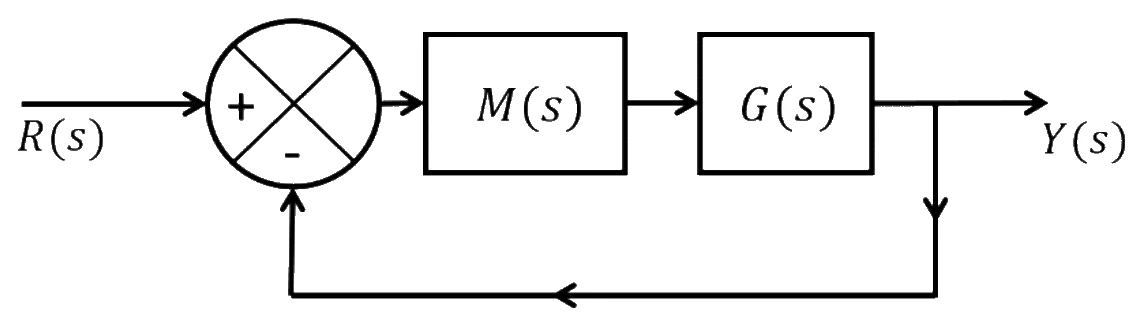
Full question on page 31 of the official paper (PDF)
Show answerHide answer
Key idea: Write the closed-loop characteristic polynomial: a missing power of s rules out stability.
Official answer: D
The closed-loop poles are the roots of 1 + M(s)G(s) = 0.
- (i) With M = K_I/s: 10s^3 + K_I = 0. The s^2 and s terms are missing, so some root is in the right half-plane (or on the axis) for every K_I > 0. No such controller works: (i) is TRUE.
- (ii) With M = K_P + sK_D: 10s^2 + K_D s + K_P = 0. A second-order polynomial with all coefficients positive has both roots in the left half-plane, so any positive K_P and K_D work: (ii) is TRUE.
Option (D).
Learn the idea:
GATE 2025, Q.37
Control Systems2 marksMCQ
For , let , and be the numbers of roots with negative real parts, purely imaginary roots, and roots with positive real parts. Which is correct?
Full question on page 32 of the official paper (PDF)
Show answerHide answer
Key idea: Every option has imaginary roots, so look for a factor s^2 + a and divide it out.
Official answer: A
Try s = j, so s^2 = -1, s^3 = -j, s^4 = 1, s^5 = j:
j + 7 - 3j + 33 + 2j - 40 = 0So s^2 + 1 is a factor, and dividing it out leaves a cubic that factors further:
The roots are \pm j, 2, -4 and -5: L = 2, I = 2, R = 1. Option (A). A Routh array gets the same counts, with a row of zeros at the s^2 + 1 factor.
Learn the idea:
GATE 2025, Q.53
Control Systems2 marksMSQ
A system has states , and and input , with . Which statements are TRUE?
One or more options are correct.
Full question on page 46 of the official paper (PDF)
Show answerHide answer
Key idea: The matrix is diagonal, so each state is a separate first-order system, and each one's pole decides what a bounded input can do to it.
Official answer: B
Each state obeys its own equation (from rest):
- \dot{x}_1 = 2x_1 + u: pole at +2. A constant u = 1 gives x_1 = (e^{2t} - 1)/2, unbounded.
- \dot{x}_2 = -2x_2 + u: pole at -2. For any input with |u| \le U, |x_2| \le U/2, so x_2 is always bounded.
- \dot{x}_3 = u: an integrator. u = 1 gives x_3 = t, unbounded.
So u = 1 makes x_1 unbounded: (B) is TRUE and (A) is FALSE. x_2 can never be unbounded, so (C) is FALSE, and u = 0 keeps everything at zero, so (D) is FALSE. Option (B).
Learn the idea:
GATE 2025, Q.56
Control Systems2 marksMSQ
Which of the signal flow graphs (A) to (D) in the figure represent the block diagram shown above them? In the block diagram, the error is formed by feeding back only 's output, and .
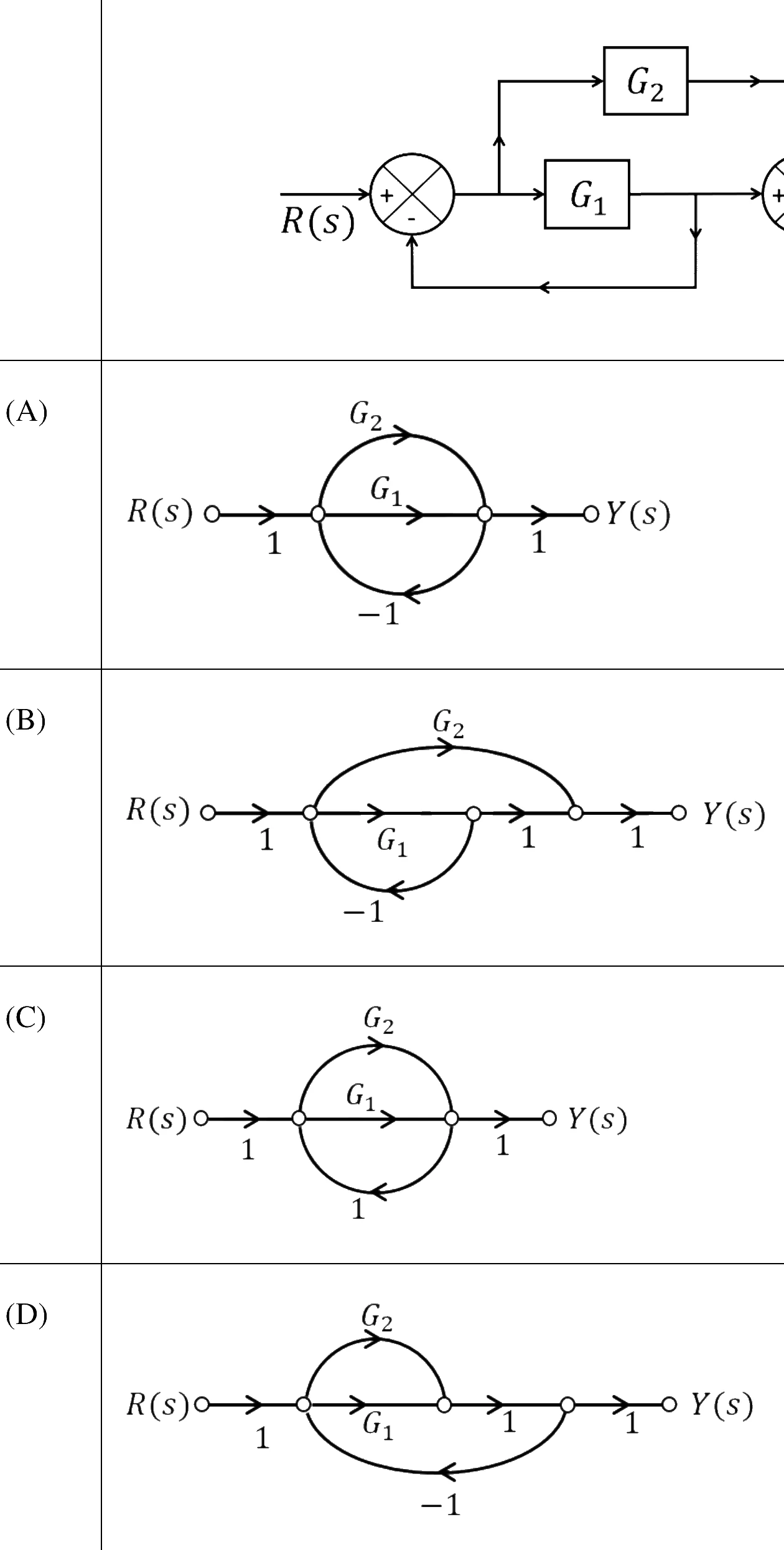
One or more options are correct.
Full question on page 48 of the official paper (PDF)
Show answerHide answer
Key idea: Find where the feedback is taken: here it is after G_1 but before G_2's path joins, so the loop gain is -G_1 alone.
Official answer: B
From the block diagram, E = R - G_1 E, so E = R/(1 + G_1), and
\frac{Y}{R} = \frac{G_1 + G_2}{1 + G_1}Graph (B) has a single loop, G_1 and the -1 branch, with forward paths G_1 and G_2 that both touch it, so Mason's rule gives (G_1 + G_2)/(1 + G_1). It matches.
In (A) and (D) the -1 branch returns from a node where G_2 has already joined, so the loop gain is -(G_1 + G_2) and the result is (G_1 + G_2)/(1 + G_1 + G_2). Graph (C) has positive feedback. Option (B) only.
GATE 2024, Q.12
Control Systems1 markMCQ
In a Bode magnitude plot, a slope of 40 dB/decade is the same as
Full question on page 10 of the official paper (PDF)
Show answerHide answer
Key idea: A decade multiplies frequency by 10 and an octave by 2, so scale the slope by \log_{10} 2.
Official answer: A
Option (A). It is the familiar 20 dB/decade, or 6 dB/octave, of one pole, doubled.
Learn the idea:
GATE 2024, Q.13
Control Systems1 markMCQ
In the unity negative-feedback loop in the figure, . If is a unit step, what happens to the error ?
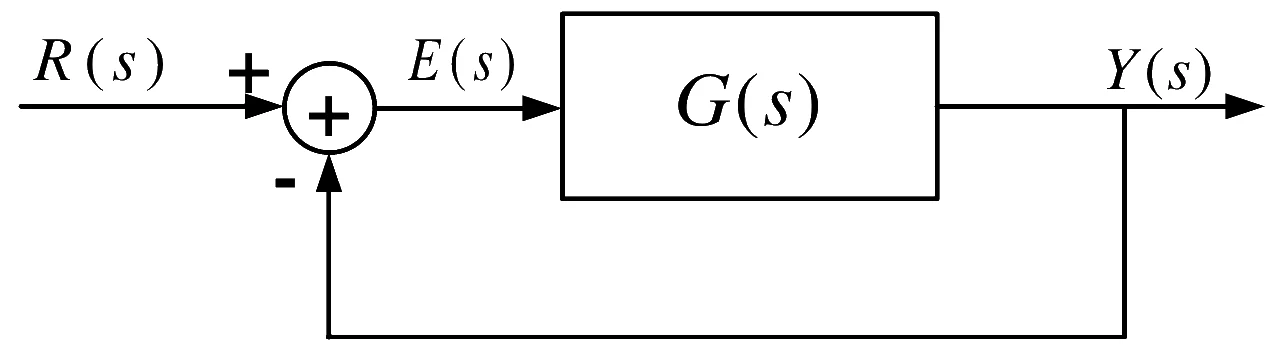
Full question on page 11 of the official paper (PDF)
Show answerHide answer
Key idea: The final value theorem only applies to a stable loop, so check the closed-loop poles before using it.
Official answer: D
The closed-loop characteristic equation is 1 + G(s) = 0:
Two poles sit on the imaginary axis at \pm j\sqrt{2}, so the loop is marginally stable and e(t) keeps oscillating. The limit doesn't exist. Option (D).
The final value theorem would give 0 for this type 1 system, option (A), but it doesn't apply when there are poles on the imaginary axis.
Learn the idea:
GATE 2024, Q.37
Control Systems2 marksMCQ
A unity negative-feedback system has forward gain . The closed-loop impulse response decays faster than if
Full question on page 28 of the official paper (PDF)
Show answerHide answer
Key idea: Decaying faster than e^{-t} means every closed-loop pole is left of s = -1; shift the axis there and apply Routh.
Official answer: A
The closed-loop poles solve (s+1)(s+2)(s+3) + K = 0. Put s = p - 1, so that p in the left half-plane means s left of -1:
For a cubic p^3 + a p^2 + b p + c, Routh needs every coefficient positive and ab > c: here K > 0 and 3 \times 2 > K. So 0 < K < 6, and only the range 1 < K < 5 lies inside it. Option (A).
Learn the idea:
GATE 2024, Q.38
Control Systems2 marksMCQ
A satellite attitude loop has plant in cascade with a compensator , , under unity negative feedback. For closed-loop poles at , what must be?
Full question on page 29 of the official paper (PDF)
Show answerHide answer
Key idea: Match the closed-loop cubic to the required quadratic factor times an unknown real pole.
Official answer: B
Poles at -1 \pm j\sqrt{3} mean a factor s^2 + 2s + 4. With a third pole at -c:
Matching gives c = 2, then K = 8 and K\alpha = 8, so \alpha = 1. Option (B).
GATE 2024, Q.53
Control Systems2 marksMSQ
System S is , . Which of these have the same transfer function?
One or more options are correct.
Full question on page 41 of the official paper (PDF)
Show answerHide answer
Key idea: Compute C(sI - A)^{-1}B for each; different realisations of one system share it.
Official answer: A and C
- (A) is the controllable canonical form of \frac{2s + 1}{s^2 + 3s + 2}: the same.
- (B) gives \frac{-4}{s^2 + 3s + 2}: different.
- (C) gives \frac{-1}{s + 1} + \frac{3}{s + 2} = \frac{2s + 1}{(s + 1)(s + 2)}: the same.
- (D) gives \frac{1}{s + 1} + \frac{2}{s + 2} = \frac{3s + 4}{(s + 1)(s + 2)}: different.
Options (A) and (C).
GATE 2023, Q.25
Control Systems1 markMCQ
The open-loop transfer function of a unity negative feedback system is , where , and are positive constants. What is the phase crossover frequency, in rad/s?
Full question on page 18 of the official paper (PDF)
Show answerHide answer
Key idea: At the phase crossover frequency the phase of G(j\omega) is -180°.
Official answer: A
So \tan^{-1}(\omega T_1) + \tan^{-1}(\omega T_2) = 90°, which needs \omega T_1 \cdot \omega T_2 = 1:
\omega_{pc} = \frac{1}{\sqrt{T_1 T_2}}Option (A).
GATE 2023, Q.41
Control Systems2 marksMCQ
The closed-loop system in the figure has unity negative feedback round , where and . What is the steady-state error due to a ramp input, ?
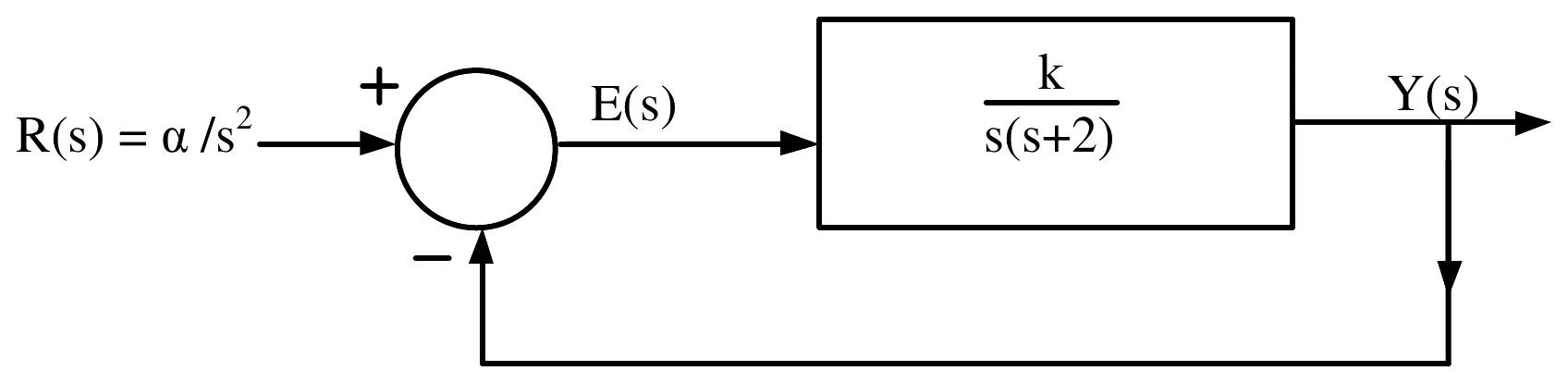
Full question on page 28 of the official paper (PDF)
Show answerHide answer
Key idea: A type-1 loop follows a ramp with a constant error, \alpha / K_v, where K_v = \lim_{s \to 0} sG(s).
Official answer: A
This holds when the loop is stable, which it is for every k > 0: the characteristic equation s^2 + 2s + k = 0 has both roots in the left half-plane. Option (A).
GATE 2023, Q.42
Control Systems2 marksMCQ
In the block diagram in the figure, and are two inputs, and the output is . What are and ?
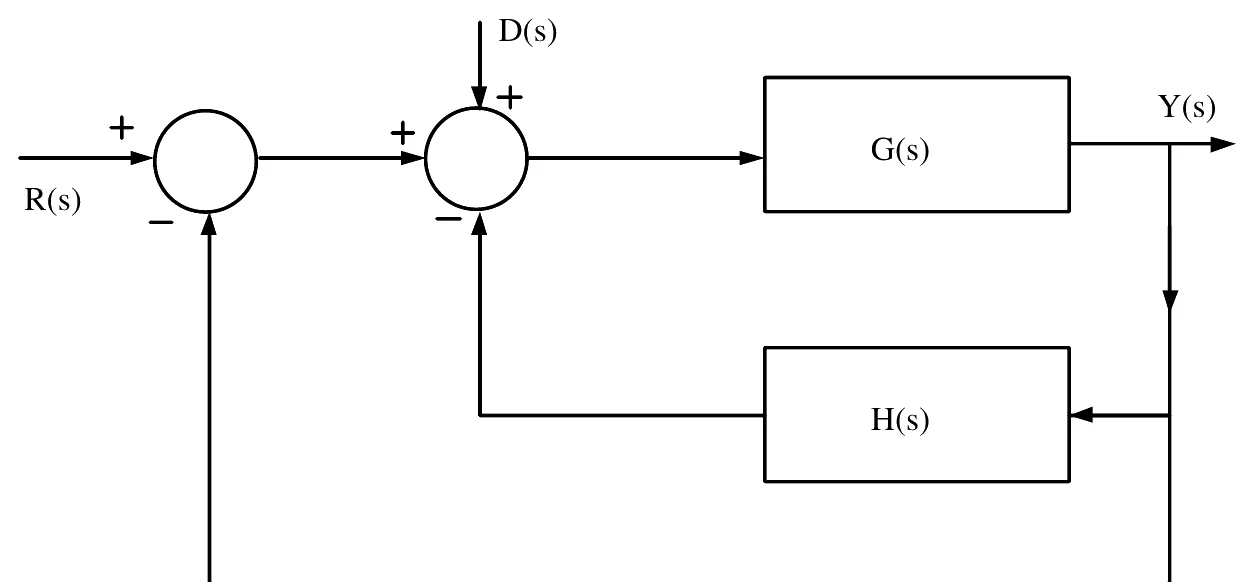
Full question on page 29 of the official paper (PDF)
Show answerHide answer
Key idea: Write the signal into G and solve once for Y; both inputs enter at the same point, so they share a denominator.
Official answer: A
The second junction adds D to the first junction's output, R - Y, and subtracts HY:
Y = G\left[(R - Y) + D - HY\right]Collecting the Y terms:
Y(1 + G + GH) = G R + G DSo G_1 = G_2 = G/(1 + G + GH). Option (A).
GATE 2023, Q.43
Control Systems2 marksMCQ
The state equation of a second-order system is , with initial condition . and are two distinct eigenvalues of , and and the corresponding eigenvectors. For constants and , what is the solution ?
Full question on page 30 of the official paper (PDF)
Show answerHide answer
Key idea: Try \mathbf{x} = e^{\lambda t}\mathbf{v}: it solves the equation exactly when A\mathbf{v} = \lambda\mathbf{v}.
Official answer: A
Distinct eigenvalues give independent eigenvectors, so every solution is \alpha_1 e^{\lambda_1 t}\mathbf{v}_1 + \alpha_2 e^{\lambda_2 t}\mathbf{v}_2, with \alpha_1, \alpha_2 fixed by \mathbf{x}(0). In (B) to (D), \dot{\mathbf{x}} would be k\lambda_i times each term, not A\mathbf{x}. Option (A).
Learn the idea:
GATE 2023, Q.57
Control Systems2 marksNAT
The figure shows the asymptotic magnitude Bode plot of a minimum-phase system: dB/decade up to , flat from to , and dB/decade beyond . Its transfer function is , where , , , , and are positive constants. What is ?
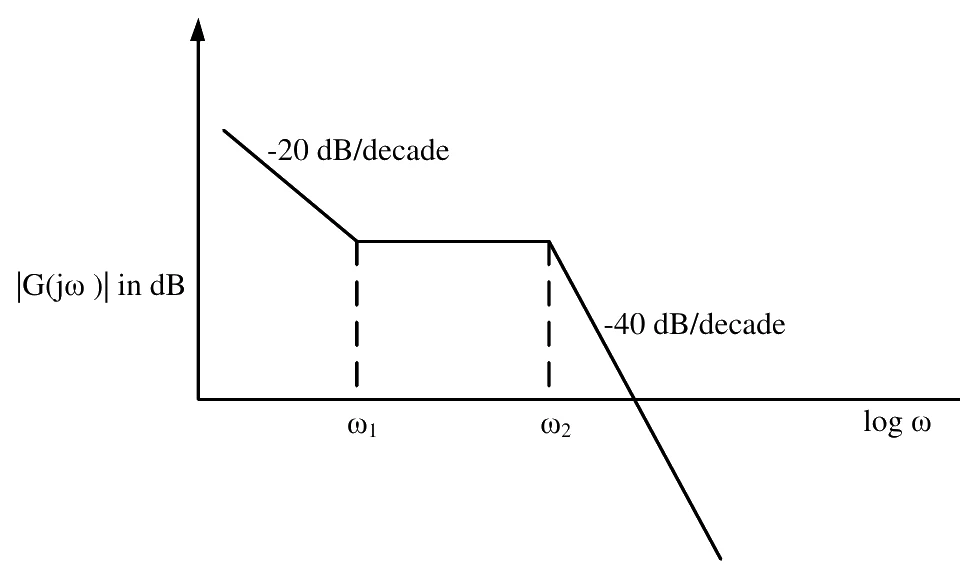
Answer format: rounded off to the nearest integer
Full question on page 41 of the official paper (PDF)
Show answerHide answer
Key idea: Each pole at the origin sets -20 dB/decade from the start; a zero adds +20 and a pole -20 dB/decade at its corner.
Official answer: 4
- -20 dB/decade from the start: one pole at the origin, b = 1.
- At \omega_1 the slope rises by 20 to 0: a single zero, a = 1, z = \omega_1.
- At \omega_2 the slope falls by 40: a double pole, c = 2, p = \omega_2.
So a + b + c = 1 + 1 + 2 = 4.
Learn the idea: