GATE 2026 EC Paper: Worked Solutions to All 65 Questions
All 65 questions of the GATE 2026 EC paper (IIT Guwahati), in paper order. Try each one, then open its answer: the official answer from the answer key and a worked solution. Every answer matches the key, and every numerical answer was recomputed from the question's values.
Q.1
General Aptitude1 markMCQ
Which word is the antonym of nocturnal?
Full question on page 1 of the official paper (PDF)
Show answerHide answer
Key idea: Nocturnal means active at night; its opposite is active by day.
Official answer: B
Of the four options, only diurnal, active during the day, is about the time of day at all, so it is the antonym. The others (normal, abnormal, exceptional) have nothing to do with time of day.
Q.2
General Aptitude1 markMCQ
In an exam out of 150: (S1) the highest score is 100; (S2) the fourth highest score is 76; (S3) at least four students scored within 25 marks of each other. Which statement is necessarily correct?
Full question on page 2 of the official paper (PDF)
Show answerHide answer
Key idea: The top four scores all lie between 76 and 100, a spread of 24.
Official answer: A
Take (S1) and (S2) together. The four highest scores all lie between the fourth highest (76) and the highest (100).
100 - 76 = 24 \le 25So those four students are within 25 marks of each other, which is (S3). Option (A) holds.
The others fail: (S3) can come from any four students, so it fixes neither the highest score nor the fourth highest, and (S1) alone says nothing about the fourth score.
Q.3
General Aptitude1 markMCQ
Three straight line segments cross a picture whose rectangular middle WXYZ is missing. Which of the four tiles P, Q, R and S completes it?
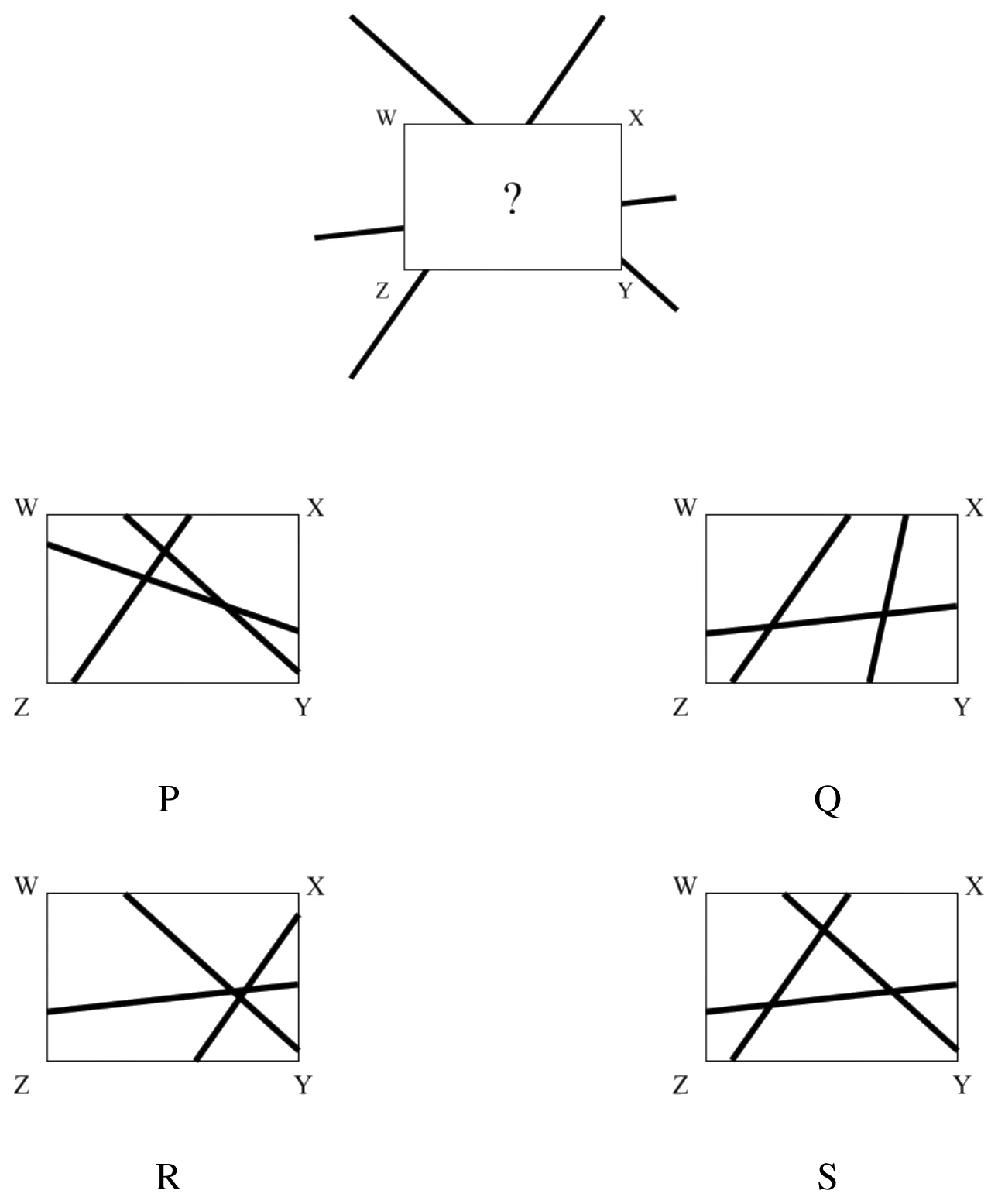
Full question on page 3 of the official paper (PDF)
Show answerHide answer
Key idea: Match each segment where it enters and leaves the hidden rectangle.
Official answer: D
Follow the stubs outside the rectangle:
- A segment comes in from the upper left through the top edge and leaves near corner Y, going down to the right.
- A segment comes in from the upper right through the top edge and leaves through the bottom edge near Z, going down to the left.
- A nearly horizontal segment enters low on the left edge and leaves higher on the right edge.
Only tile S has all three: two lines crossing from the top edge to the bottom corners, and one shallow line rising from left to right. Tile R has a line starting at corner X, which the stubs don't show. The answer is S, option (D).
Q.4
General Aptitude1 markMCQ
Real numbers , and , all greater than 1, satisfy . Find .
Full question on page 4 of the official paper (PDF)
Show answerHide answer
Key idea: Taking the nth root of a base multiplies the logarithm by n.
Official answer: B
Change both logarithms to plain \log:
Since \log_p y \cdot \log_y p = 1, the product is n^2 = 16, so n = 4 (all quantities exceed 1, so n > 0). Option (B).
Learn the idea:
Q.5
General Aptitude1 markMCQ
The statement for each of 100 students, there is another student whose score is at most 10 marks away is false. Which statement must be true?
Full question on page 5 of the official paper (PDF)
Show answerHide answer
Key idea: Negating for every ... there exists gives there exists ... for every.
Official answer: B
Apply it to the statement: for every student becomes there exists a student, and there exists another student within 10 marks becomes every other student is more than 10 marks away.
That is option (B). Options (A) and (D) make claims about every student, and (C) says exactly one, neither of which follows from the negation.
Q.6
General Aptitude2 marksMCQ
Solve four clue words: a synonym of recognize (8 letters, _D_NT_FY), a story long enough to fill a book (5, ___EL), two of something (6, ___PLE), one of two equal parts (4, ___F). Their first letters rearrange into which four-letter word?
Full question on page 6 of the official paper (PDF)
Show answerHide answer
Key idea: Solve the clues first, then rearrange the four first letters.
Official answer: A
- Synonym of recognize, 8 letters: IDENTIFY.
- A story long enough for a book, 5 letters: NOVEL.
- Two of something, 6 letters: COUPLE.
- One of two equal parts, 4 letters: HALF.
The first letters I, N, C, H rearrange to CHIN. Option (A).
Q.7
General Aptitude2 marksMCQ
Children P, Q, R and parents X, Y play doubles. X and Y each have a different child playing, so exactly one child has no parent playing. A parent and their child never play on the same team, and a match has at most one parent-child pair. Matches: P and X vs Q and R; P and R vs X and Y; R and X vs Q and Y. Which is correct?
Full question on page 7 of the official paper (PDF)
Show answerHide answer
Key idea: Teammates can't be parent and child, and a match can't hold two parent-child pairs.
Official answer: C
Look at who plays together in each match:
- Match 1 (P and X together): X is not P's parent.
- Match 3 (R and X together, Q and Y together): X is not R's parent, and Y is not Q's parent.
So X's child is Q, and Y's child is P or R.
Rule (ii) allows at most one parent-child pair in a match. Match 3 already has X against Q. If Y were R's parent, match 3 would also have Y against R: two pairs. So Y is P's parent, and R has no parent playing. Option (C).
Q.8
General Aptitude2 marksMCQ
is the perimeter of a square of side . Find .
Full question on page 8 of the official paper (PDF)
Show answerHide answer
Key idea: P_k = 4k, so the sum is 4 times the sum of 1 to 10.
Official answer: C
Option (C).
Learn the idea:
Q.9
General Aptitude2 marksMCQ
Atlantis is an island of radius 2.5 stades, surrounded by rings of water 1, land 2, water 2, land 3 and water 3 stades wide. Find the ratio of land area to water area.
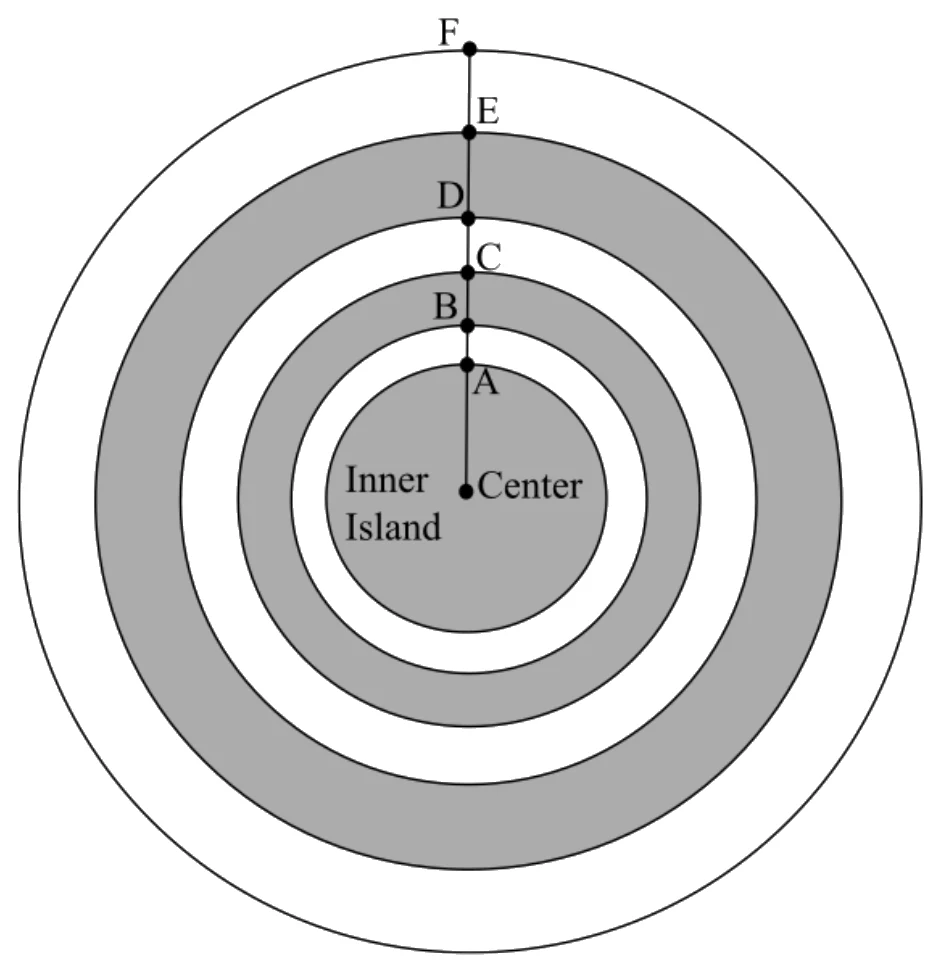
Full question on page 9 of the official paper (PDF)
Show answerHide answer
Key idea: Every ring's area is \pi(R^2 - r^2), so \pi cancels in the ratio.
Official answer: C
The boundaries are at radii 2.5, 3.5, 5.5, 7.5, 10.5 and 13.5. Every area is \pi times a difference of squares, so \pi cancels:
The ratio is 78.25 / 104 \approx 0.75. Option (C).
Learn the idea:
Q.10
General Aptitude2 marksMCQ
The example shows how the two-line block Ref Fig / 12 34 is transformed. Which of the tiles P, Q, R and S applies the same transformation to the block GATE - 2026 / Aptitude Test?
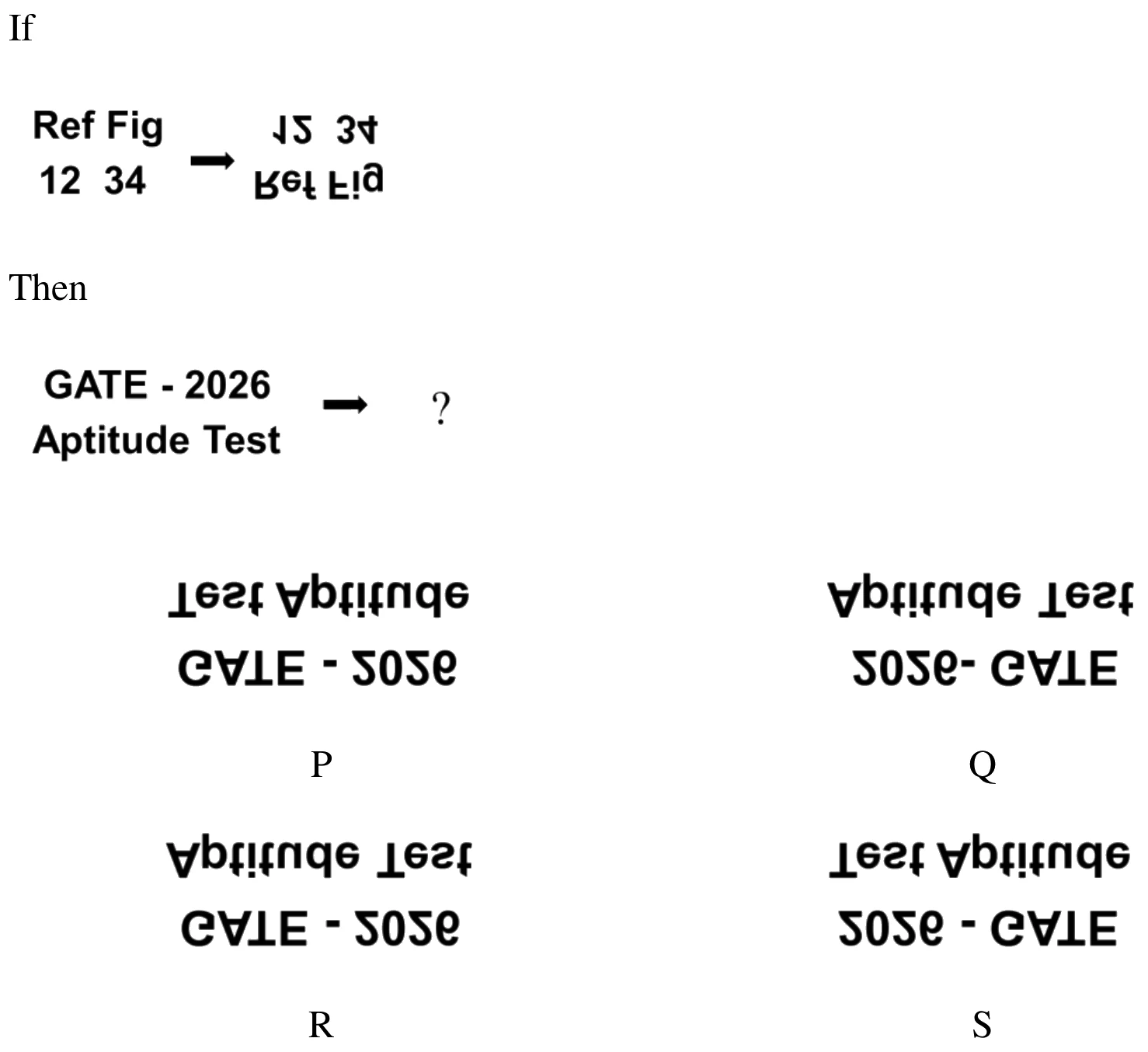
Full question on page 10 of the official paper (PDF)
Show answerHide answer
Key idea: The example is a reflection in a horizontal mirror.
Official answer: C
In the example, the two lines swap places and every character is flipped upside down, while each line still runs left to right. That is a reflection in a horizontal mirror.
Applied to the new block, the second line moves to the top and both lines appear upside down but in their original left-to-right order. Tile R shows exactly that. P also swaps the two words of one line, Q swaps the parts of the other line, and S does both, which the example never does. Option (C).
Q.11
Engineering Mathematics1 markMCQ
The solution of with is . Which matrix is ?
Full question on page 11 of the official paper (PDF)
Show answerHide answer
Key idea: Each component evolves on its own, so A is diagonal with the exponents on its diagonal.
Official answer: A
Differentiate each component and compare it with the component itself:
Option (A).
Learn the idea:
Q.12
Engineering Mathematics1 markMCQ
and are the unit normals to the surface at the point . Which vector can be?
Full question on page 12 of the official paper (PDF)
Show answerHide answer
Key idea: The gradient of the surface function is normal to the surface.
Official answer: D
Write the surface as f = 2x^2 - y^2 - z^2 = 0 and take its gradient at (1, 0, \sqrt{2}):
This is a multiple of (\sqrt{2}, 0, -1), whose length is \sqrt{3}, so a unit normal is
\vec{n} = \frac{\sqrt{2}\,\hat{i} - \hat{k}}{\sqrt{3}}Option (D). Options (A) and (C) aren't unit vectors, and (B) points the wrong way.
Learn the idea:
Q.13
Networks, Signals and Systems1 markMCQ
Find the Laplace transform of , where is convolution.
Full question on page 13 of the official paper (PDF)
Show answerHide answer
Key idea: Convolution in time is multiplication of Laplace transforms.
Official answer: D
Transform each factor and multiply:
Option (D).
Learn the idea:
Q.14
Electronic Devices1 markMCQ
Which carrier transport mechanism dominates the current in a Zener diode in breakdown?
Full question on page 14 of the official paper (PDF)
Show answerHide answer
Key idea: A heavily doped junction is thin enough for band-to-band tunnelling.
Official answer: C
In reverse breakdown, the field across a Zener diode's very thin depletion region is strong enough for electrons to tunnel straight from the valence band on the p side to the conduction band on the n side. That tunnelling carries the current. Option (C).
Avalanche breakdown, in lightly doped junctions at higher voltages, works by impact ionisation instead; the question asks about the Zener mechanism.
Learn the idea:
Q.15
Networks, Signals and Systems1 markMCQ
and , for , are both sampled at Hz. Compare their first ten samples.
Full question on page 15 of the official paper (PDF)
Show answerHide answer
Key idea: 50 Hz sampled at 40 Hz aliases onto 10 Hz.
Official answer: D
At F_s = 40 Hz, the sample times are t = n/40:
The 50 Hz signal aliases onto 10 Hz, so every sample is identical. Option (D) is the only statement that holds; (A), (B) and (C) all need one set of samples to be greater.
Q.16
Networks, Signals and Systems1 markMCQ
A system obeys , with input . Describe the response .
Full question on page 16 of the official paper (PDF)
Show answerHide answer
Key idea: The input's zero cancels one of the system's poles.
Official answer: A
The input cancels the pole at 1/3. The response starts at n = 0 (causal) and decays (stable). Option (A).
Learn the idea:
Q.17
Analog Circuits1 markMCQ
A non-inverting op-amp stage has 1 kΩ from the inverting input to ground and, as feedback, 2 kΩ in series with 1 kΩ, with a switch S across the 1 kΩ. With S open the output is . Find with S closed.
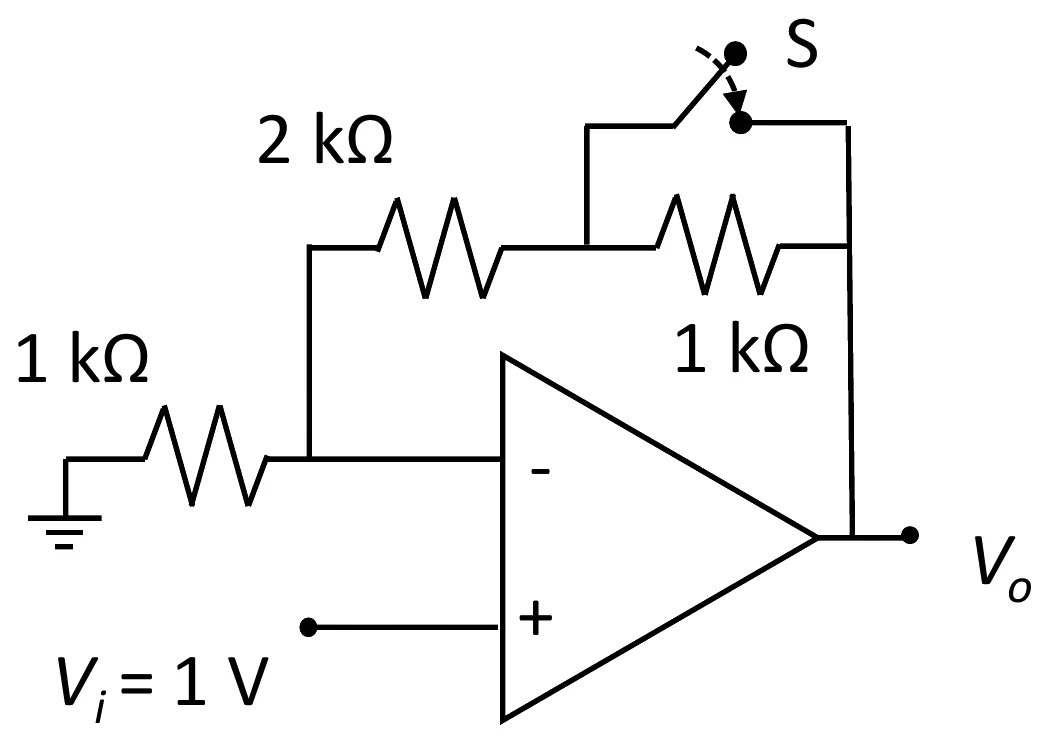
Full question on page 17 of the official paper (PDF)
Show answerHide answer
Key idea: A non-inverting gain is 1 + R_f/R_g; closing S removes 1 kΩ from R_f.
Official answer: C
Take the two switch positions in turn, with R_g = 1 kΩ.
- Switch open: R_f = 3 kΩ, gain 4, so x = 4V_i.
- Switch closed: the 1 kΩ is shorted, R_f = 2 kΩ, gain 3, so V_o = 3V_i.
V_o = \tfrac{3}{4}x. Option (C).
Learn the idea:
Q.18
Analog Circuits1 markMCQ
An op-amp drives a BJT's base and senses the voltage across its 1 kΩ emitter resistor, with V at the op-amp input and V. With V and , find the base current .
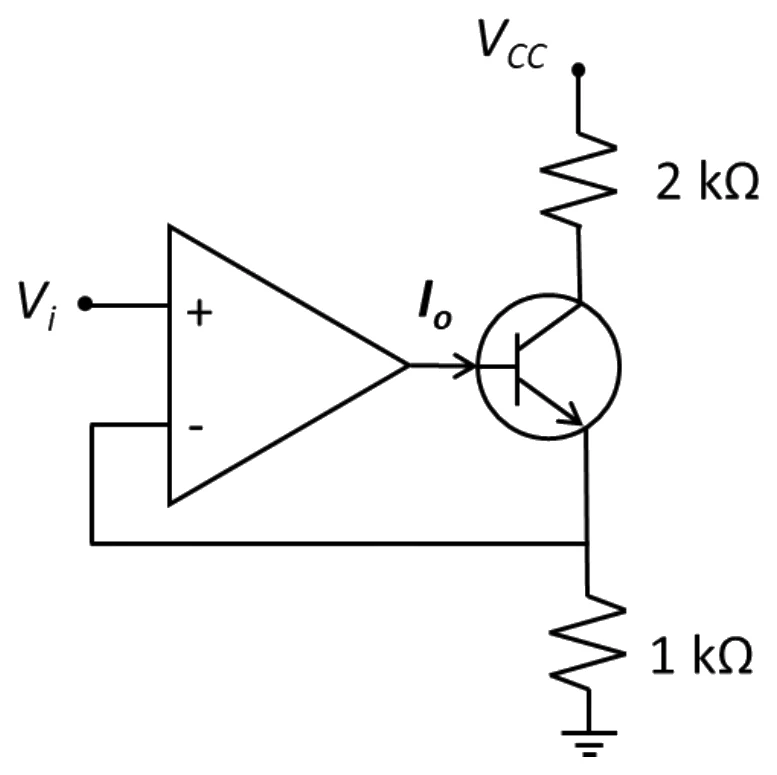
Full question on page 18 of the official paper (PDF)
Show answerHide answer
Key idea: Feedback holds the emitter at V_i, which fixes I_E; then I_B = I_E/(\beta + 1).
Official answer: D
The emitter sits at V_i = 3 V, across the 1 kΩ resistor. So
Check the BJT is active: V_C = 12 - 2\text{ k}\Omega \times 2.97\text{ mA} \approx 6.06 V, above the emitter. Option (D).
Learn the idea:
Q.19
Control Systems1 markMCQ
An error signal feeds two identical blocks; the output is taken from one, and the feedback is the difference of the two outputs. Find .
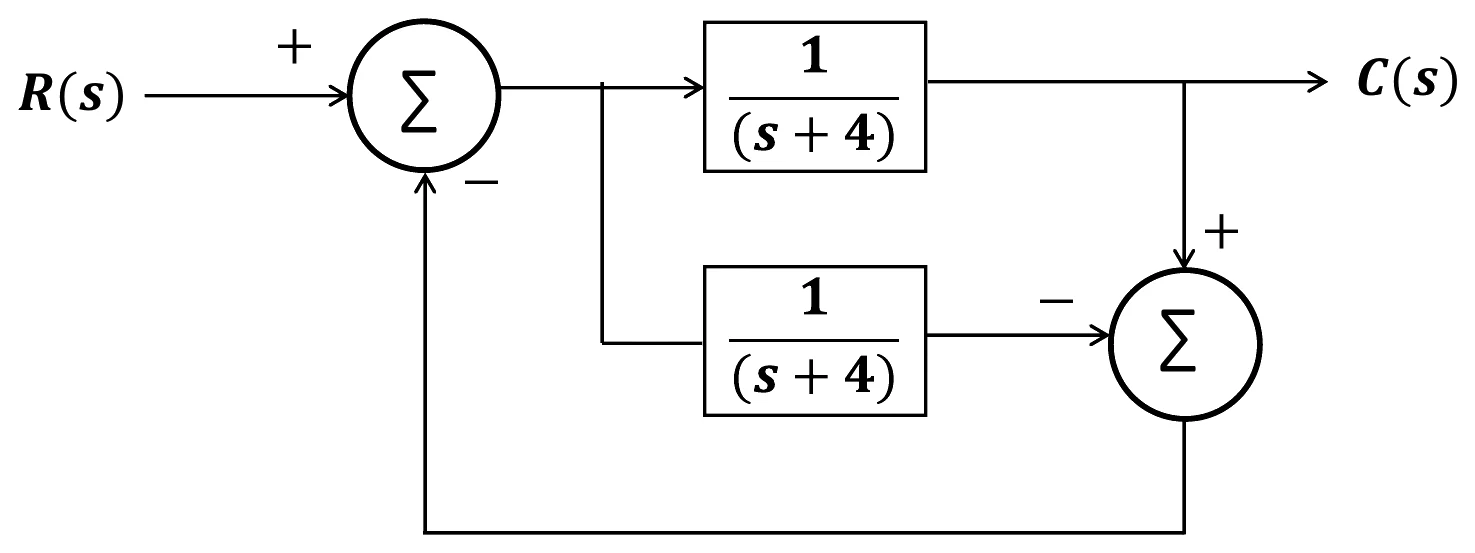
Full question on page 19 of the official paper (PDF)
Show answerHide answer
Key idea: Two identical blocks driven by the same signal give identical outputs, so the feedback is zero.
Official answer: B
Call the error signal E. Both blocks see E, so their outputs are equal, E/(s+4). The feedback is their difference, which is zero:
Option (B).
Q.20
Digital Circuits1 markMCQ
Two PMOS transistors in series pull the output up to VDD, and two NMOS transistors in parallel pull it down, gated by A and B. Which logic function is Y?
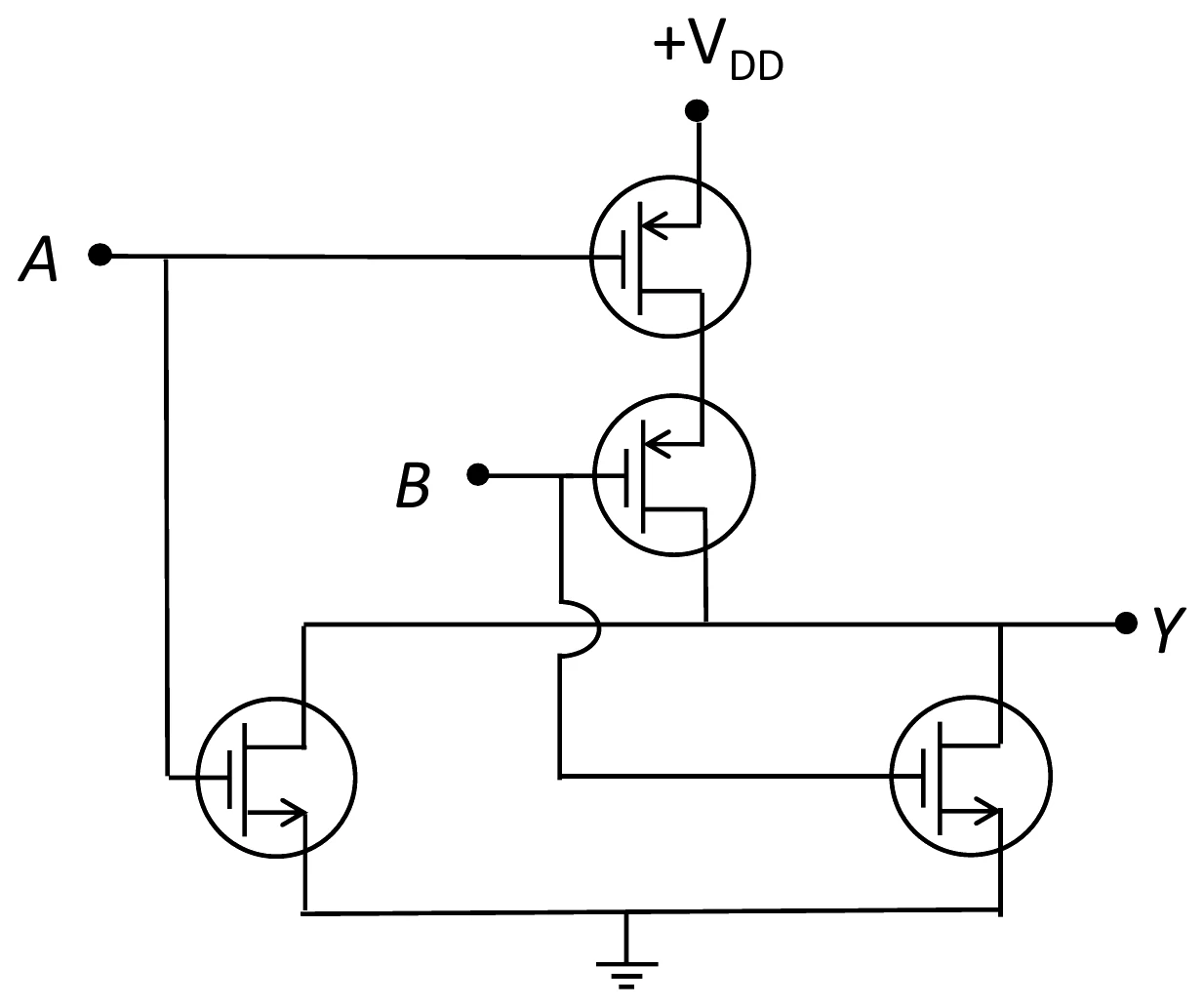
Full question on page 20 of the official paper (PDF)
Show answerHide answer
Key idea: Series pull-up and parallel pull-down is the NOR structure.
Official answer: A
The pull-up network (PMOS in series) conducts only when A = 0 and B = 0. The pull-down network (NMOS in parallel) conducts when A = 1 or B = 1.
Y = \overline{A + B}That is NOR. Option (A).
Learn the idea:
Q.21
Electromagnetics1 markMCQ
Using Friis' equation with , m, dBm and dBm, find the distance in km.
Full question on page 21 of the official paper (PDF)
Show answerHide answer
Key idea: A 100 dB path loss is a power ratio of 10^{-10}.
Official answer: B
Here P_R/P_T is -90 - 10 = -100 dB. Set the Friis ratio equal to it:
Option (B).
Learn the idea:
Q.22
Communications1 markMCQ
A four-level signal (levels ) carries random symbols per second. Find its equivalent Nyquist bandwidth.
Full question on page 22 of the official paper (PDF)
Show answerHide answer
Key idea: Nyquist bandwidth depends on the symbol rate only: half of it.
Official answer: C
With a symbol rate of R_s = 10^4 symbols per second, the number of levels doesn't enter:
B = \frac{R_s}{2} = \frac{10^4}{2} = 5\text{ kHz}Option (C).
Q.23
Networks, Signals and Systems1 markMCQ
A circuit obeys and is driven by , with . Which source-free problem is equivalent?
Full question on page 23 of the official paper (PDF)
Show answerHide answer
Key idea: An impulse of current delivers its charge instantly, so it only shifts the initial voltage.
Official answer: A
Integrate the equation across t = 0. The impulse delivers charge q in zero time, while m(t) (finite) contributes nothing over an instant:
After that, C\,dV/dt = -m(t). So the impulse is equivalent to starting the source-free equation from V_0 + q/C. Option (A), which writes this initial value at t = 0^- for the equivalent problem.
Learn the idea:
Q.24
Electromagnetics1 markMCQ
A plane wave in a lossless medium has . What is its polarization?
Full question on page 24 of the official paper (PDF)
Show answerHide answer
Key idea: Equal amplitudes 90 degrees apart give circular polarization; the rotation sense fixes the hand.
Official answer: A
At z = 0 the field points along \hat{x} at t = 0 and along \hat{y} a quarter period later, with the same magnitude: it is circular, turning from x towards y.
The wave travels along +z. With the right thumb along +z, the fingers curl from x to y, so the wave is right-handed circularly polarized (IEEE convention). Option (A).
Q.25
Electronic Devices1 markMSQ
A p-n junction is forward biased at 2 V. What is the separation between the quasi-Fermi levels and ?
One or more options are correct.
Full question on page 25 of the official paper (PDF)
Show answerHide answer
Key idea: An applied bias V splits the quasi-Fermi levels by qV.
Official answer: A
At a forward bias of 2 V the split is q \times 2 V = 2 eV, option (A).
Options (C) and (D) give an energy in volts, which isn't an energy unit, and 1 eV doesn't match the bias. The official key lists (A) only.
Learn the idea:
Q.26
Engineering Mathematics1 markMSQ
For , which values of and make ?
One or more options are correct.
Full question on page 26 of the official paper (PDF)
Show answerHide answer
Key idea: Write \det M in terms of a and b, then keep the options where it isn't zero.
Official answer: B and D
Expand along the first row:
- (A) a = b = -\tfrac{1}{2}: -\tfrac{1}{2} - \tfrac{5}{2} + 3 = 0.
- (B) a = b = \tfrac{1}{2}: 6 \neq 0.
- (C) a = -3, b = 0: 0.
- (D) a = \tfrac{1}{2}, b = -3: -11.5 \neq 0.
Options (B) and (D).
Learn the idea:
Q.27
Digital Circuits1 markMSQ
How many flip-flops does a binary ripple counter need to count from 0 to 64?
One or more options are correct.
Full question on page 27 of the official paper (PDF)
Show answerHide answer
Key idea: 65 states need 2^n \ge 65.
Official answer: B
Six flip-flops give 2^6 = 64 states, one short of the 65 needed for 0 to 64, so n = 7 (2^7 = 128). Option (B) only.
Learn the idea:
Q.28
Electromagnetics1 markMSQ
Which expressions describe the dielectric loss tangent of a substrate?
One or more options are correct.
Full question on page 28 of the official paper (PDF)
Show answerHide answer
Key idea: The loss tangent is the in-phase (lossy) current over the quadrature current.
Official answer: A and B
With \epsilon = \epsilon' - j\epsilon'' and conductivity \sigma, Ampère's law gives the total current density
The loss tangent is the ratio of the in-phase (lossy) part to the quadrature part:
\tan\delta = \frac{\omega\epsilon'' + \sigma}{\omega\epsilon'}That is option (B), and option (A) describes the same ratio in words. Susceptibility over permittivity (C) and P over D (D) measure how polarizable the material is, not its loss.
Learn the idea:
Q.29
Electronic Devices1 markMSQ
Two BJTs at the same base current: in the active region, BJT 1's collector current rises more steeply with VCE than BJT 2's. Compare their Early voltages |VA1| and |VA2|.
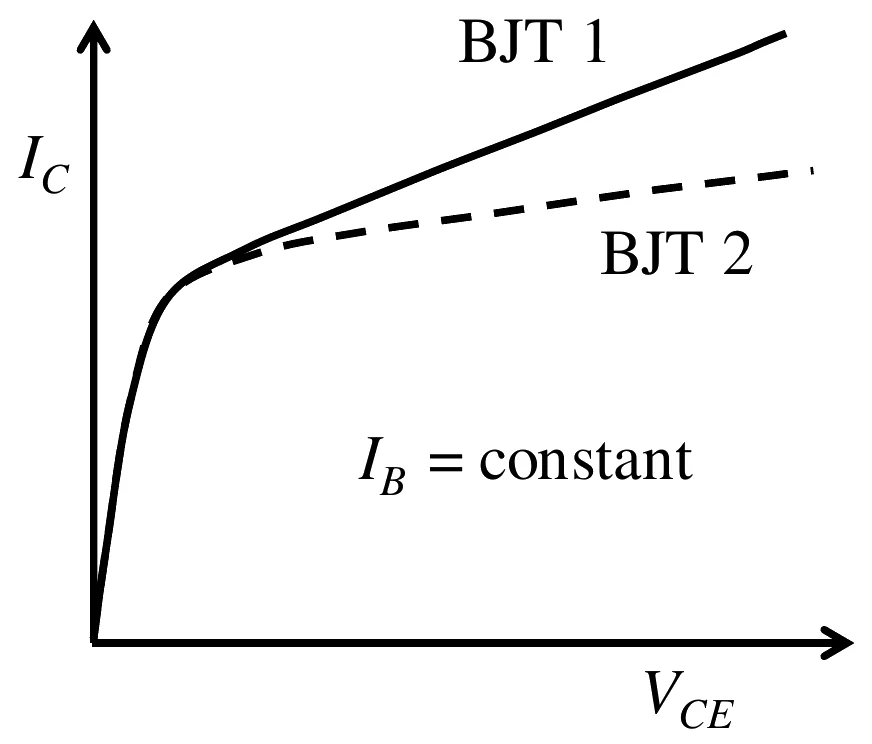
One or more options are correct.
Full question on page 29 of the official paper (PDF)
Show answerHide answer
Key idea: The active-region slope is about I_C/|V_A|: the steeper curve has the smaller Early voltage.
Official answer: C and D
Compare the two active-region slopes at the same I_C:
- BJT 1 is steeper, so |V_{A1}| < |V_{A2}|: option (C).
- BJT 2 still has a nonzero slope, so |V_{A2}| is finite: option (D).
- BJT 1 has the steeper slope, so its Early voltage is certainly not infinite, which rules out (B), and (A) is the reverse of (C).
Learn the idea:
Q.30
Networks, Signals and Systems1 markNAT
A 1 mA source feeds two parallel branches, each of two 1 kΩ resistors in series, and a 6 V battery joins the two branch midpoints. Find the output voltage across the source.
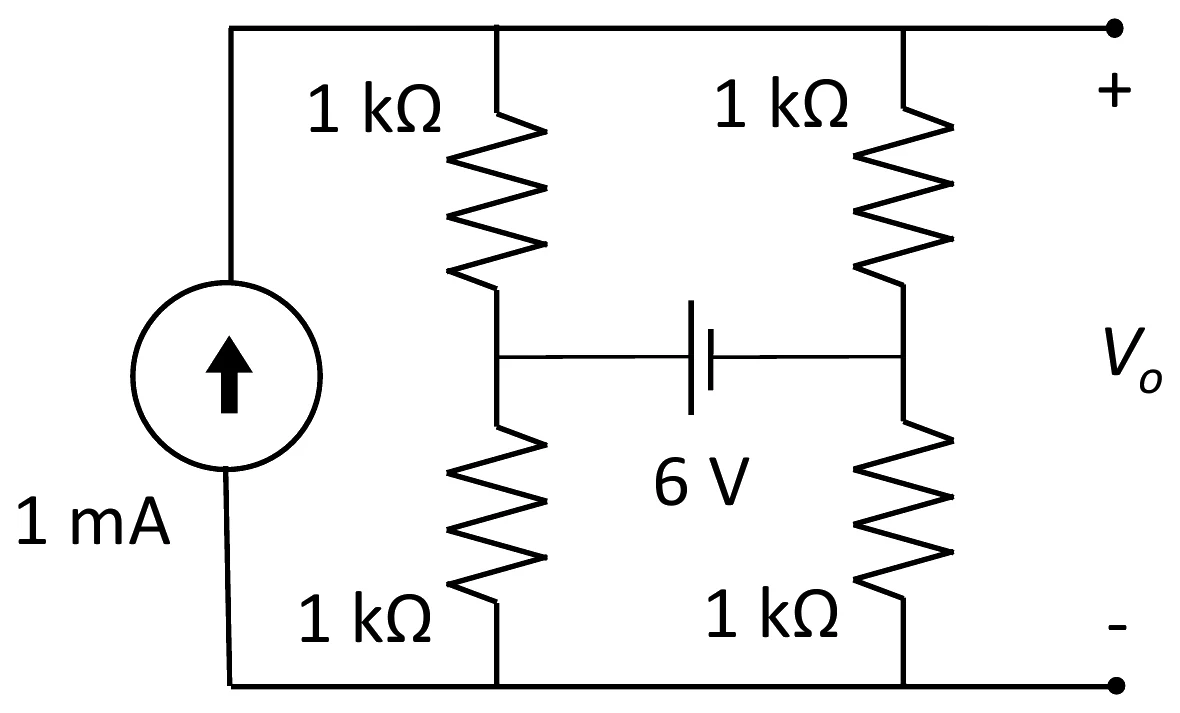
Answer format: Volts, rounded off to two decimal places
Full question on page 30 of the official paper (PDF)
Show answerHide answer
Key idea: The battery's current leaves one midpoint and enters the other, so it cancels from the sum of the node equations.
Official answer: 0.95 to 1.05
Let the bottom rail be 0 V, the top rail T, and the midpoints L and R (volts, kΩ, mA). Whatever current i the battery carries leaves one midpoint and enters the other, so it cancels when the two midpoint equations are added:
At the top rail, the source current leaves through the two upper resistors:
So V_o = 1.00 V, whatever the battery voltage.
Learn the idea:
Q.31
Networks, Signals and Systems1 markNAT
A source V drives 1 µF, 2.2 mH and 1 kΩ, all in parallel across it. Find the average power in the 1 kΩ resistor at resonance.
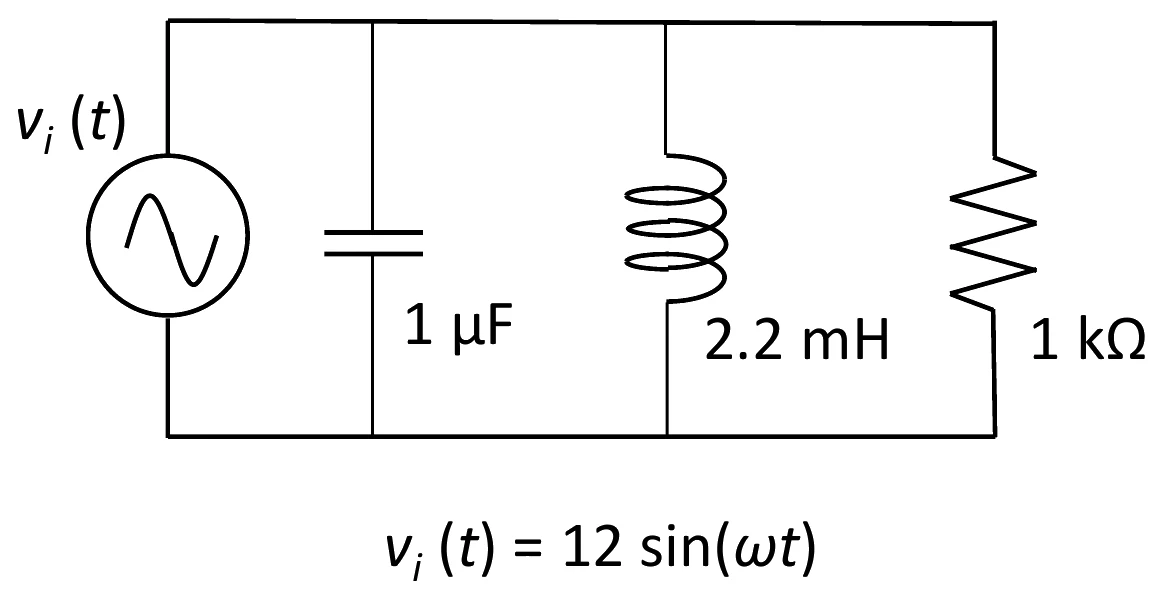
Answer format: Milliwatts, rounded off to two decimal places
Full question on page 31 of the official paper (PDF)
Show answerHide answer
Key idea: The resistor sits directly across the ideal source, so resonance doesn't change its voltage.
Official answer: 71.50 to 72.50
The resistor sees the full 12 V peak, so
Resonance only makes the L and C currents cancel; it doesn't change the resistor's voltage.
Learn the idea:
Q.32
Communications1 markNAT
16-QAM carries bit/s over an AWGN channel. Find the minimum transmission bandwidth.
Answer format: MHz, rounded off to two decimal places
Full question on page 31 of the official paper (PDF)
Show answerHide answer
Key idea: Minimum passband bandwidth equals the symbol rate.
Official answer: 0.95 to 1.05
16-QAM carries \log_2 16 = 4 bits per symbol, so the symbol rate is 1 Msymbol/s. A passband signal needs at least the symbol rate in bandwidth (Nyquist pulses, both sidebands):
Q.33
Electromagnetics1 markNAT
Find the cutoff frequency of the TE10 mode in an air-filled rectangular waveguide of 0.28 inch by 0.14 inch.
Answer format: GHz, rounded off to two decimal places
Full question on page 31 of the official paper (PDF)
Show answerHide answer
Key idea: f_c = c/(2a) with a the broad dimension.
Official answer: 20.50 to 21.50
Q.34
Electromagnetics1 markNAT
and cross at dB for a lossless two-port and at dB for a lossy one. What percentage of the incident power does the lossy network dissipate at the crossing?
Answer format: Percent, rounded off to two decimal places
Full question on page 31 of the official paper (PDF)
Show answerHide answer
Key idea: Power lost inside is 1 - |S_{11}|^2 - |S_{21}|^2.
Official answer: 20.00 to 21.00
At the crossing both magnitudes are -4 dB:
About 20.38% is dissipated. (For the lossless network, 2 \times 10^{-0.3} \approx 1, as it should be.)
Learn the idea:
Q.35
Digital Circuits1 markNAT
A negative-edge JK flip-flop with J and K tied high is clocked by a 10 Hz square wave. Find the frequency of Q.
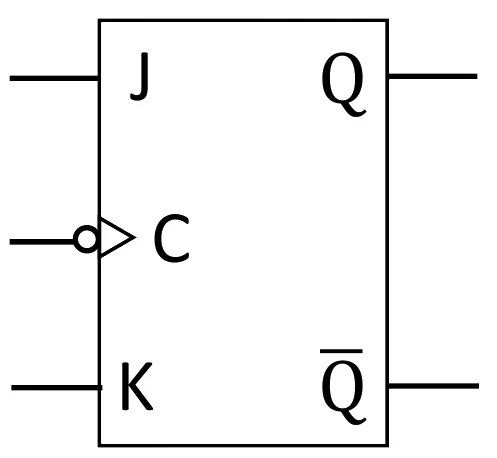
Answer format: Hz (cycles per second), rounded off to two decimal places
Full question on page 32 of the official paper (PDF)
Show answerHide answer
Key idea: J = K = 1 toggles Q on every clock edge, halving the frequency.
Official answer: 4.90 to 5.10
The clock has 10 falling edges a second and Q changes on each one, so Q completes 5 cycles a second: 5.00 Hz.
Learn the idea:
Q.36
Engineering Mathematics2 marksMCQ
Do and converge?
Full question on page 33 of the official paper (PDF)
Show answerHide answer
Key idea: Ratio test for the first; compare the second with a geometric series.
Official answer: A
For S_A, use the ratio test:
So S_A converges (its sum is in fact 6).
Every term of S_B is a different power of \tfrac{1}{2} (the exponents run 0, 1, 3, 4, 6, 7, 9, and so on). Its partial sums are therefore bounded by the full geometric series:
S_B \le \sum_{k=0}^{\infty} \left(\tfrac{1}{2}\right)^k = 2A series of positive terms with bounded partial sums converges (its sum is 12/7). Both converge. Option (A).
Q.37
Networks, Signals and Systems2 marksMCQ
A real periodic signal with period and Fourier coefficients satisfies . For any integer , which is correct?
Full question on page 34 of the official paper (PDF)
Show answerHide answer
Key idea: Half-wave symmetry removes the even harmonics.
Official answer: A
A shift by T/2 multiplies the nth coefficient by e^{-j\pi n} = (-1)^n. The condition x(t - T/2) = -x(t) then says, coefficient by coefficient,
For even n the bracket is 2, so a_{2m} = 0. This is half-wave symmetry: only odd harmonics survive. Option (A).
Learn the idea:
Q.38
Engineering Mathematics2 marksMCQ
is uniform on and is an independent standard normal. With and , find the correlations and .
Full question on page 35 of the official paper (PDF)
Show answerHide answer
Key idea: Independence and E[N] = 0 remove the noise terms, leaving E[X^2] and E[X^3].
Official answer: A
Here correlation means E[XY] (the correlation coefficient of X and Y is 1/2, which isn't an option). Independence and E[N] = 0 remove the noise terms:
The second is zero because x^3 is odd and X is symmetric about 0. Option (A).
Learn the idea:
Q.39
Networks, Signals and Systems2 marksMCQ
An - branch and an - branch ( µH, µF) are in parallel across . At 159.15 kHz their currents are apart (). Find the nearest integer to .
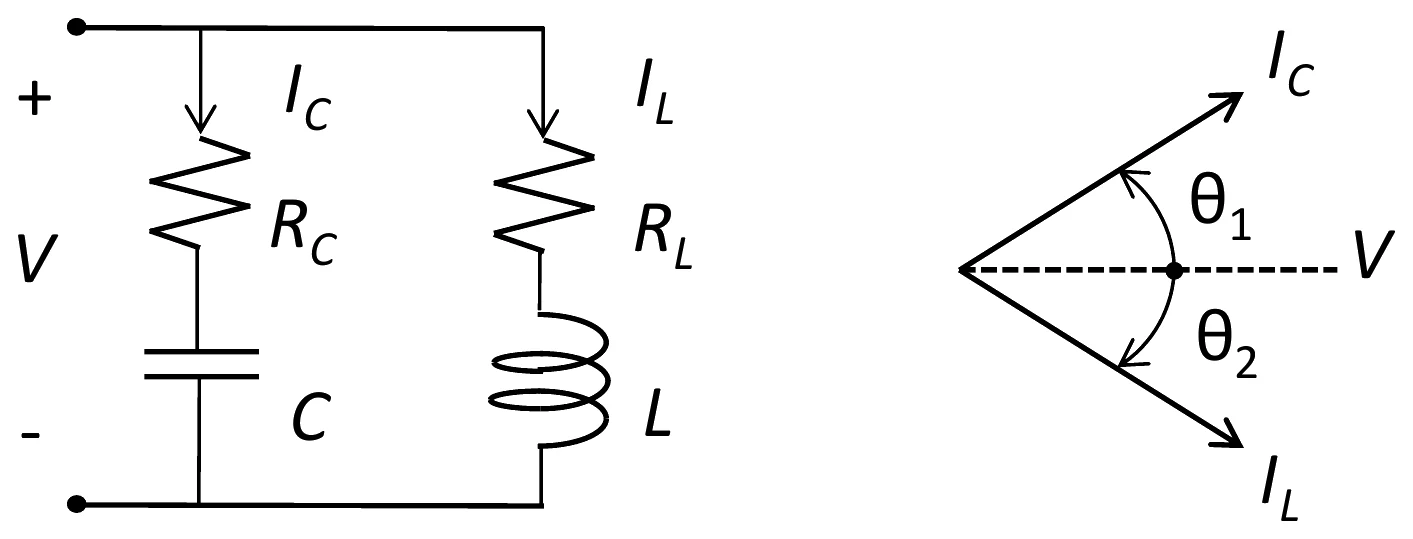
Full question on page 36 of the official paper (PDF)
Show answerHide answer
Key idea: Two angles add to 90^\circ when the product of their tangents is 1.
Official answer: B
At 159.15 kHz, \omega = 2\pi f = 10^6 rad/s, so both reactances are 1 Ω:
I_C leads V by \theta_1 and I_L lags it by \theta_2, with
Two angles add to 90° exactly when the product of their tangents is 1:
Option (B).
Learn the idea:
Q.40
Control Systems2 marksMCQ
Unity negative feedback is applied around , with and . Which puts the closed-loop poles at ?

Full question on page 37 of the official paper (PDF)
Show answerHide answer
Key idea: Match the characteristic polynomial to the one the target poles give.
Official answer: B
The closed-loop characteristic equation is 1 + C(s)G(s) = 0:
The required poles give
(s + 3)^2 + 5 = s^2 + 6s + 14Matching coefficients: 3 + K = 6, so K = 3; and 2 + 3\alpha = 14, so \alpha = 4. Option (B).
Learn the idea:
Q.41
Control Systems2 marksMCQ
Find for and .
Full question on page 38 of the official paper (PDF)
Show answerHide answer
Key idea: The transfer function is C(sI - A)^{-1}B.
Official answer: C
Option (C).
Learn the idea:
Q.42
Digital Circuits2 marksMCQ
A 256 KB memory starts at address 2500H. What is its last address?
Full question on page 39 of the official paper (PDF)
Show answerHide answer
Key idea: Last address = first address + size - 1, with 256 KB = 40000H.
Official answer: C
256 KB is 256 \times 1024 = 2^{18} byte locations, 40000H in hex, so
Option (C).
Q.43
Networks, Signals and Systems2 marksMCQ
for and 0 elsewhere. Find the ratio of the energy of to the energy of .
Full question on page 40 of the official paper (PDF)
Show answerHide answer
Key idea: Energy goes with the square of the amplitude and with the duration; shifting or reversing a signal leaves it unchanged.
Official answer: C
E[x] = \int_0^1 2^2\,dt = 4Scaling the amplitude by 3 multiplies the energy by 9. Compressing time by a factor of 3 divides it by 3. Shifting and reversing don't change it:
The ratio is 4/12 = 1/3. Option (C).
Learn the idea:
Q.44
Communications2 marksMCQ
Coherent QPSK over AWGN is received at dB. Using , find the nearest bit error rate.
Full question on page 41 of the official paper (PDF)
Show answerHide answer
Key idea: QPSK has the same bit error rate as BPSK: \tfrac{1}{2}\mathrm{erfc}\sqrt{E_b/N_0}.
Official answer: B
For Gray-coded coherent QPSK:
P_b = \tfrac{1}{2}\,\mathrm{erfc}\!\left(\sqrt{E_b/N_0}\right)Convert the ratio: E_b/N_0 = 10^{0.84} \approx 6.92, so u = \sqrt{6.92} \approx 2.63. With the given approximation,
The nearest option is 10^{-4}. Option (B).
Learn the idea:
Q.45
Digital Circuits2 marksMCQ
Find the 10's complement of the decimal number 47.
Full question on page 42 of the official paper (PDF)
Show answerHide answer
Key idea: The 10's complement of a two-digit number N is 100 - N.
Official answer: B
For the two-digit number 47:
10^2 - 47 = 53Equivalently, the 9's complement (52) plus 1. Option (B).
Q.46
Networks, Signals and Systems2 marksMCQ
For , , 99% of the energy lies within Hz. Which is true of ?
Full question on page 43 of the official paper (PDF)
Show answerHide answer
Key idea: Integrate |X(f)|^2 from -B to B and set it to 99% of the total energy.
Official answer: B
The total energy is \int_0^\infty e^{-4t}\,dt = \tfrac{1}{4}. The energy in -B < f < B is
As a fraction of the total, that is \tfrac{2}{\pi}\tan^{-1}(\pi B). Setting it to 0.99:
So B \approx 63.66/\pi \approx 20.3 Hz, between 63/\pi and 64/\pi. Option (B).
Q.47
Networks, Signals and Systems2 marksMCQ
A system S is built from two LTI subsystems and , two adders and two unit delays, as in the figure. Which statement is necessarily true?
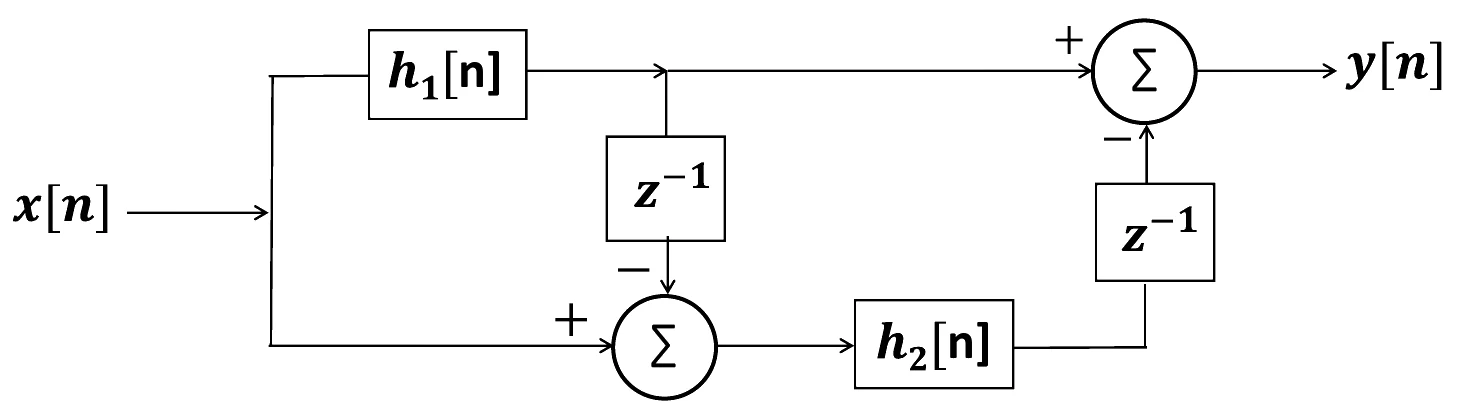
Full question on page 44 of the official paper (PDF)
Show answerHide answer
Key idea: Any interconnection of LTI blocks is LTI, but causality depends on the blocks.
Official answer: B
Reading the figure, the output is
Every block (the two subsystems, the delays and the adders) is linear and time invariant, and any interconnection of LTI blocks is LTI. In the z-domain the whole system is a single transfer function:
So (B) holds, and (C) and (D) are false. Causality (A) isn't guaranteed: nothing says h_1[n] or h_2[n] is zero for n < 0, and if h_1[n] isn't, neither is the overall impulse response. Option (B).
Learn the idea:
Q.48
Digital Circuits2 marksMCQ
A 4:1 MUX has select lines and and inputs , , , . Find .
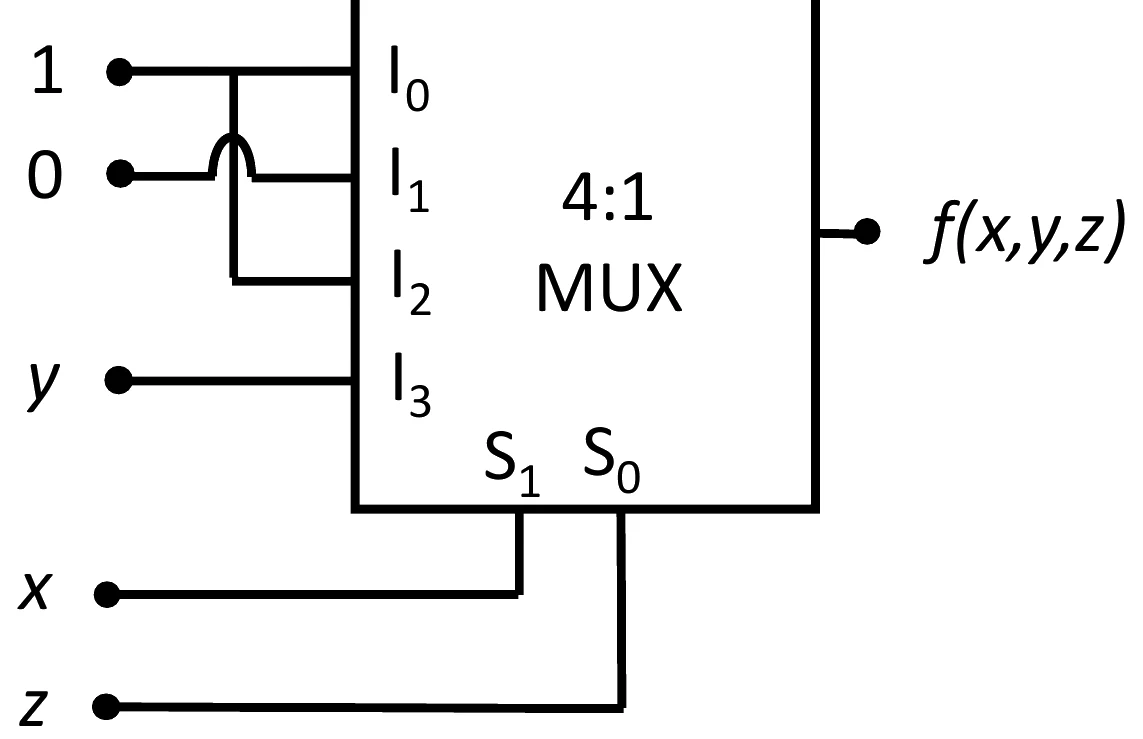
Full question on page 45 of the official paper (PDF)
Show answerHide answer
Key idea: Write the MUX output as a sum of select-line minterms times their inputs, then simplify.
Official answer: C
In the figure, I_2 is wired to the same line as I_0 (logic 1), and the 0 line crosses over it to I_1. The MUX output is
The last step uses \bar{z} + z\,(xy) = \bar{z} + xy. Option (C).
Learn the idea:
Q.49
Digital Circuits2 marksMCQ
An 8-bit shift-left register feeds into a D flip-flop, and feeds . Starting from all zeros, what does the register hold ( to ) after the 5th rising edge?
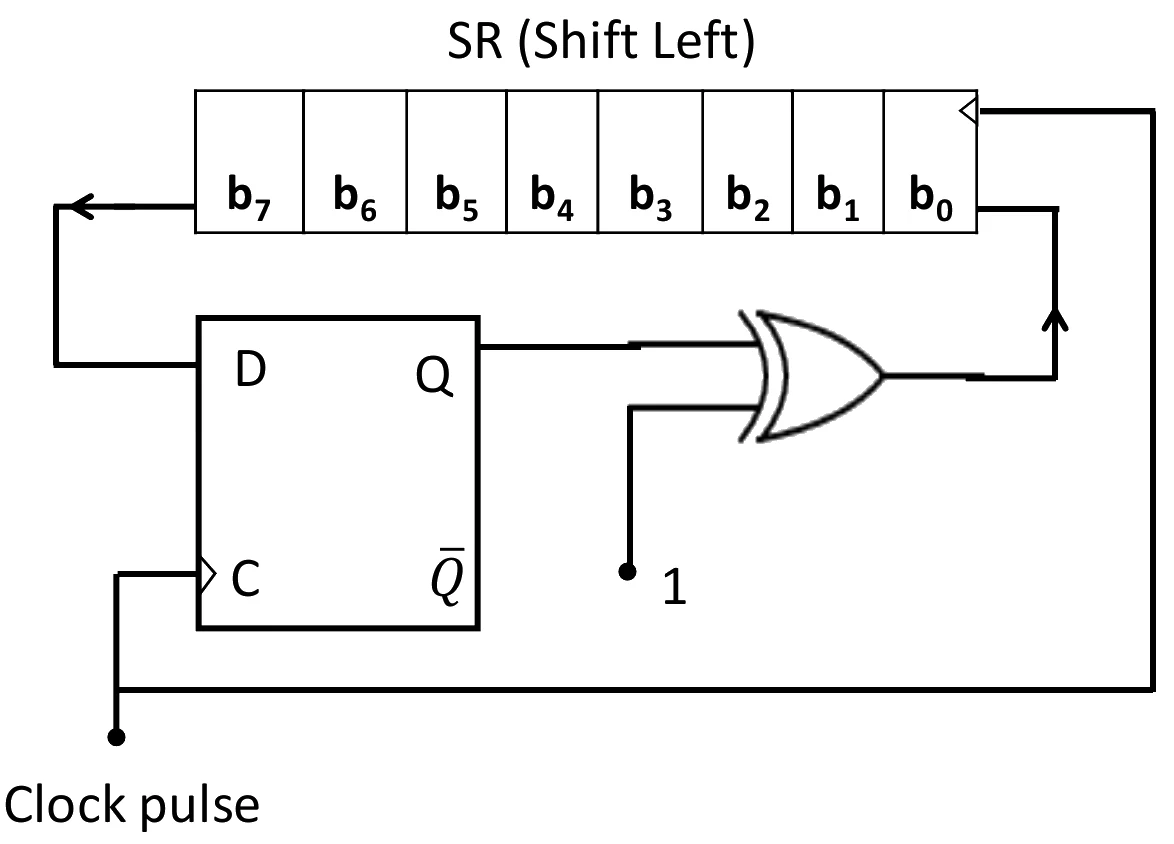
Full question on page 46 of the official paper (PDF)
Show answerHide answer
Key idea: The serial input is \bar{Q}, and Q stays 0 until a 1 reaches b_7.
Official answer: A
The serial input to b_0 is Q \oplus 1 = \bar{Q}. On each edge, the register shifts left taking in \bar{Q}, while the flip-flop takes in the old b_7.
| Edge | Q before | Serial in | to after | Q after |
|---|---|---|---|---|
| 1 | 0 | 1 | 00000001 | 0 |
| 2 | 0 | 1 | 00000011 | 0 |
| 3 | 0 | 1 | 00000111 | 0 |
| 4 | 0 | 1 | 00001111 | 0 |
| 5 | 0 | 1 | 00011111 | 0 |
b_7 stays 0 for the first eight edges, so Q stays 0 and a 1 enters every time. Option (A).
Learn the idea:
Q.50
Analog Circuits2 marksMCQ
A voltage-divider biased common-emitter stage (100 kΩ and 25 kΩ divider, 5 kΩ collector, 500 Ω unbypassed and 1 kΩ bypassed in the emitter, 12 V supply, , V) is driven by . Which is the best approximation of ?
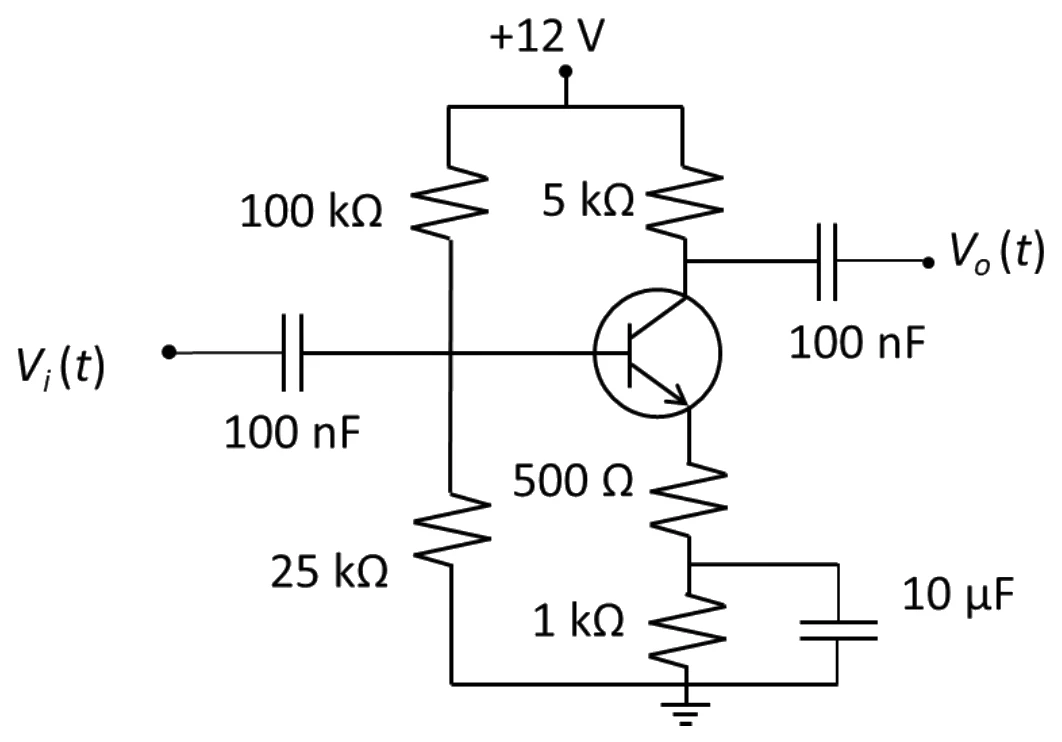
Full question on page 47 of the official paper (PDF)
Show answerHide answer
Key idea: The capacitors are shorts at both frequencies, so both tones see the same gain \approx -R_C/(r_e + 500).
Official answer: A
Bias. The divider gives a Thévenin source of 12 \times 25/125 = 2.4 V behind 100\,\|\,25 = 20 kΩ. With I_B = I_E/100 and 1.5 kΩ in the emitter:
Capacitors. At \omega = 10^5 rad/s, the 10 µF bypass is 1 Ω against 1 kΩ, and the 100 nF input capacitor is 100 Ω against an input resistance of about 14.5 kΩ. At 10^7 rad/s they are smaller still. Both act as shorts at both frequencies, and the output capacitor carries no current into an open output.
Gain. Only the 500 Ω stays in the emitter for signals:
The same gain applies to both tones, with no phase shift between them, so
The nearest is option (A). Option (C), -190.4, is the gain with the 500 Ω bypassed as well, which the circuit doesn't do.
Note: The exact gain is -9.40, not the option's -9.1. The 500 Ω makes the transistor's output resistance far larger than r_o = 100 V/1 mA, so r_o barely matters. The option's value comes from putting r_o straight across R_C: (5\text{ k}\,\|\,100\text{ k})/525 \approx 9.07. Either way, (A) is the nearest option.
Learn the idea:
Q.51
Networks, Signals and Systems2 marksMCQ
Find the ABCD parameters of a T network with 1 kΩ in each series arm and 1 kΩ in the shunt arm.
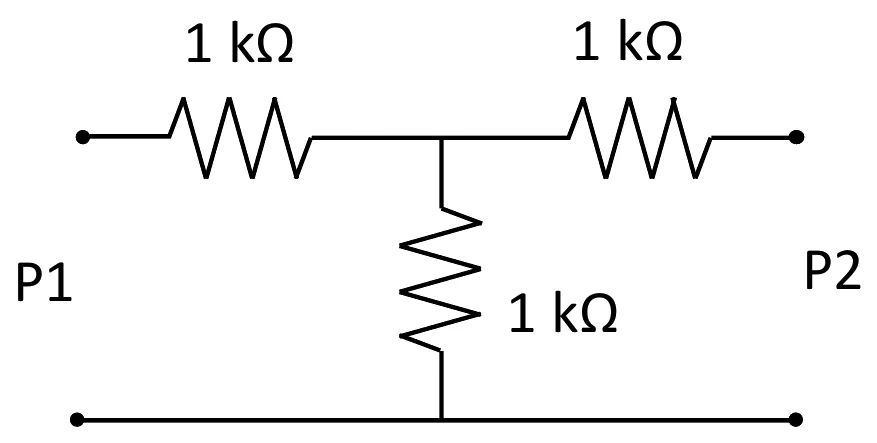
Full question on page 48 of the official paper (PDF)
Show answerHide answer
Key idea: Find A and C with the output open, and B and D with it shorted.
Official answer: D
For a T network with series arms Z_1, Z_2 and shunt arm Z_3:
With all three at 1 kΩ: A = D = 2, B = 3 \times 10^3 Ω and C = 10^{-3} Ω⁻¹. As a check, AD - BC = 4 - 3 = 1, as it must be for a reciprocal network. Option (D).
Learn the idea:
Q.52
Electromagnetics2 marksMCQ
A load has on a 50 Ω coaxial cable. Its input impedance moves to the diametrically opposite point on the same circle. Find the nearest input impedance.
Full question on page 49 of the official paper (PDF)
Show answerHide answer
Key idea: The opposite point has \Gamma_{in} = -\Gamma_L; then Z = 50\,\frac{1+\Gamma}{1-\Gamma}.
Official answer: B
Rotate \Gamma_L by 180° (a quarter wavelength of line):
Option (B). The load itself is Z_L \approx 97.7 + j65.1 Ω (close to option (D)), and the two satisfy Z_{in}Z_L = 50^2, as a quarter-wave line requires.
Learn the idea:
Q.53
Analog Circuits2 marksMCQ
An inverting amplifier has 1 kΩ in, from V, and 1 kΩ of feedback to a node N. N is driven from the op-amp output through 2 kΩ (current , towards the output) and loaded by 2 kΩ to ground. Find .
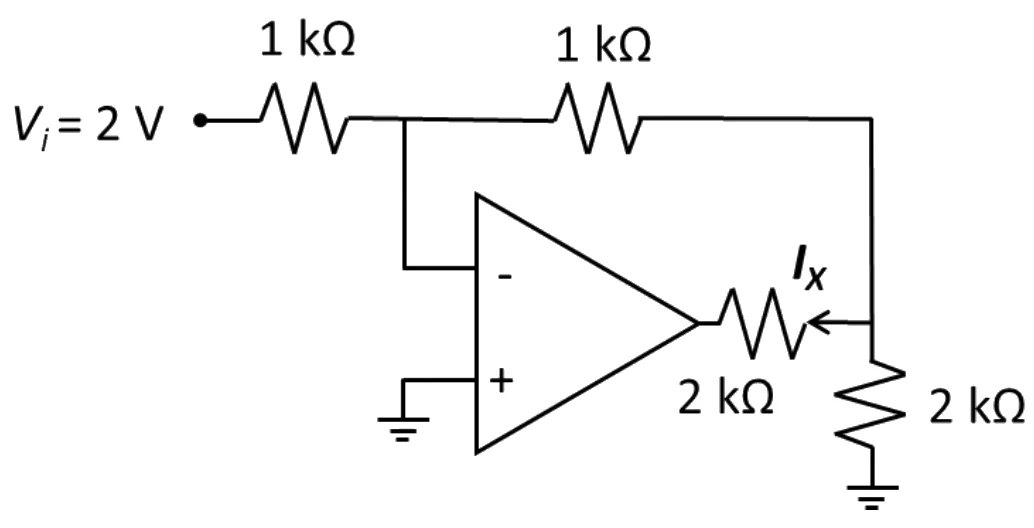
Full question on page 50 of the official paper (PDF)
Show answerHide answer
Key idea: The virtual ground fixes the feedback current, which fixes N's voltage; then apply KCL at N.
Official answer: C
The inverting input is a virtual ground. The input current 2\text{ V}/1\text{ k}\Omega = 2 mA flows on through the 1 kΩ feedback resistor, so the node at its far end (call it N) sits at
KCL at N: 2 mA arrives through the feedback resistor, and 1 mA arrives from ground through the 2 kΩ load (since N is at -2 V). Both leave through the 2 kΩ towards the op-amp output, in the direction of I_X:
I_X = 2 + \frac{0 - (-2)}{2} = 3\text{ mA}The op-amp output sits at -2 - 3 \times 2 = -8 V. Option (C).
Learn the idea:
Q.54
Electronic Devices2 marksMSQ
An LED uses a direct-gap semiconductor with eV ( J s, m/s). In which wavelength bands will it not emit?
One or more options are correct.
Full question on page 51 of the official paper (PDF)
Show answerHide answer
Key idea: An LED emits in a narrow band just above the gap, at \lambda \approx hc/E_g.
Official answer: A, B and D
The peak wavelength is set by the bandgap:
- 1410 nm (0.88 eV) and 1090 nm (1.14 eV) need photons below the gap. No transition gives them, so no emission: (A) and (B).
- 950 ± 20 nm contains 956 nm: the LED emits here.
- 510 nm (2.43 eV) is more than 1 eV above the gap. Carriers relax to the band edges before recombining, so the emission band (a few kT wide) doesn't reach it: (D).
Options (A), (B) and (D).
Learn the idea:
Q.55
Communications2 marksMSQ
Bandwidth MHz, dBm/Hz and received power dBm over an additive Gaussian channel. What is true of the Shannon capacity ?
One or more options are correct.
Full question on page 52 of the official paper (PDF)
Show answerHide answer
Key idea: Find the SNR in dB, then C = B\log_2(1 + \text{SNR}).
Official answer: C
Noise power in 1 MHz (60 dB-Hz):
So C > 3B is the only true statement. Option (C).
Learn the idea:
Q.56
Digital Circuits2 marksMSQ
, with as MSB. Which expressions equal ?
One or more options are correct.
Full question on page 53 of the official paper (PDF)
Show answerHide answer
Key idea: Group the minterms on a K-map; minterm 14 can be covered two ways.
Official answer: A and D
Plotting the nine minterms gives these groups:
- 0, 2, 8, 10 (the four corners): \bar{x}\bar{z}.
- 5, 7, 13, 15 (x = 1, z = 1): xz.
- 14 is left (w = 1, x = 1, y = 1, z = 0). It pairs with 15 as wxy, or with 10 as wy\bar{z}.
These are options (A) and (D). Option (B) has no term covering minterms 0 and 2 (it gives 0 at w = 0, x = 0, z = 0), and option (C) has no term covering 5 and 7. Options (A) and (D).
Learn the idea:
Q.57
Communications2 marksMSQ
A real narrowband signal is , where and vary slowly compared with . Which statements are correct?
One or more options are correct.
Full question on page 54 of the official paper (PDF)
Show answerHide answer
Key idea: Any narrowband signal around a carrier can be written with a slowly varying envelope and phase.
Official answer: A, B and C
Check whether each signal fits the form A(t)\cos[2\pi f_c t + \theta(t)]:
- PSK: constant A(t), and \theta(t) stepping between the symbol phases. True, (A).
- AM: A(t) = A_c[1 + k_a m(t)] and \theta(t) = 0. True, (B).
- Band-limited Gaussian noise around f_c: its envelope (Rayleigh) and phase (uniform) are random processes, but the form is the same. True, (C).
- Narrowband FM: constant A(t) and \theta(t) = 2\pi k_f \int m(\tau)\,d\tau with a small peak deviation. So x(t) can represent it, and (D), which says it never can, is false.
Options (A), (B) and (C).
Learn the idea:
Q.58
Networks, Signals and Systems2 marksMSQ
Let and for a positive integer . Which statements are valid?
One or more options are correct.
Full question on page 55 of the official paper (PDF)
Show answerHide answer
Key idea: x_2 is at twice x_1's frequency; orthogonality depends on the interval you integrate over.
Official answer: A, C and D
x_1 has frequency n and x_2 has frequency 2n. Multiply them with the product-to-sum identity
2\sin a\cos b = \sin(a+b) + \sin(a-b)and the product is
- Over 0 \le t < 1/n, both sines run through whole cycles, so the inner product is 0: orthogonal. True, (A).
- Orthonormal also needs unit energy, but \int_0^{1/n}\cos^2(2\pi nt)\,dt = 1/(2n), which is never 1 for a positive integer n (and x_2's energy is 2/n). False, (B).
- x_2's frequency 2n is twice x_1's, so x_2 is the second harmonic of x_1. True, (C).
- Over 0 \le t < 1/(2n), \sin(6\pi nt) runs through 1.5 cycles and \sin(2\pi nt) through half a cycle, so neither integral cancels:
So they are not orthogonal over that interval. True, (D). Options (A), (C) and (D).
Note: Option (C) uses harmonic in its usual sense: a sinusoid at a whole-number multiple of a fundamental frequency. Here x_2, at 2n, is the second harmonic of the fundamental n of x_1, so the key includes (C).
Learn the idea:
Q.59
Control Systems2 marksNAT
Unity negative feedback is applied around . Find the gain at which the system is marginally stable.
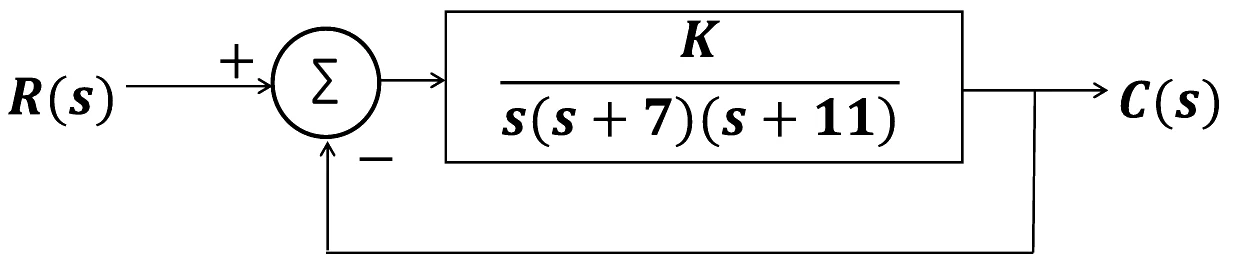
Answer format: Integer
Full question on page 56 of the official paper (PDF)
Show answerHide answer
Key idea: For s^3 + as^2 + bs + K, the Routh array hits the stability edge at K = ab.
Official answer: 1386
The characteristic equation is
For a cubic s^3 + a s^2 + b s + c, the Routh array's s^1 row is (ab - c)/a. It reaches zero, the edge of stability, when
K = 18 \times 77 = 1386At that gain the auxiliary equation 18s^2 + 1386 = 0 gives poles at s = \pm j\sqrt{77} \approx \pm j8.77 rad/s, on the imaginary axis. K = 1386.
Learn the idea:
Q.60
Analog Circuits2 marksNAT
An NMOS has its gate tied to its drain, which is fed from V through 1 kΩ ( V, mA/V², no channel-length modulation). Find the gate voltage .
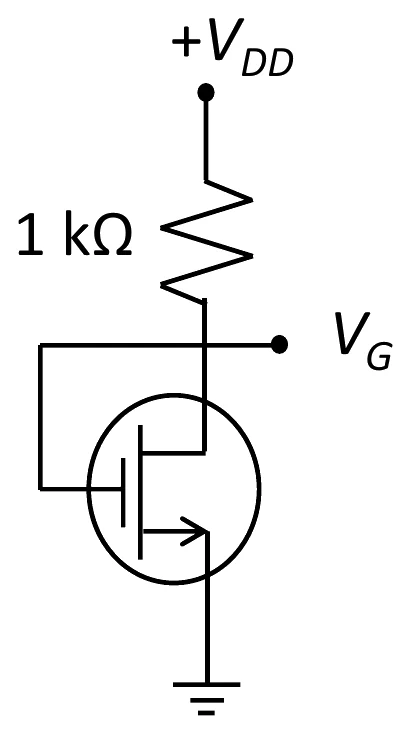
Answer format: Volts, rounded off to two decimal places
Full question on page 56 of the official paper (PDF)
Show answerHide answer
Key idea: A diode-connected MOSFET is always in saturation; equate the resistor and drain currents.
Official answer: 2.50 to 2.60
Call the gate voltage V. Since V_{DS} = V_{GS} > V_{GS} - V_{TH}, the transistor is saturated, and the resistor current equals the drain current (mA, V):
The other root is negative, below threshold, so it's rejected. The drain current is 5 - 2.56 = 2.44 mA. V_G \approx 2.56 V.
Q.61
Engineering Mathematics2 marksNAT
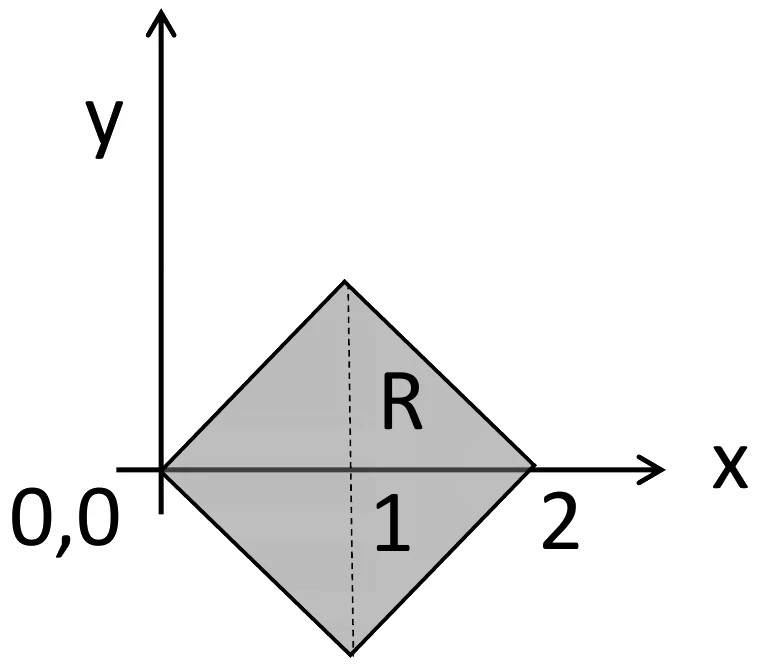
Evaluate over the square with corners , , and .
Answer format: A number, rounded off to two decimal places
Full question on page 57 of the official paper (PDF)
Show answerHide answer
Key idea: Use the square's polar moment about its centre, then shift the centre to (1, 0).
Official answer: 0.60 to 0.70
The square has diagonals of length 2, so its area is 2 and its side is \sqrt{2}. Its centre is (1, 0).
For a square of area A and side s, \iint (u^2 + v^2) about its centre is A s^2/6, whatever its orientation. Shifting the centre to (1, 0) adds A \times 1^2:
Learn the idea:
Q.62
Analog Circuits2 marksNAT
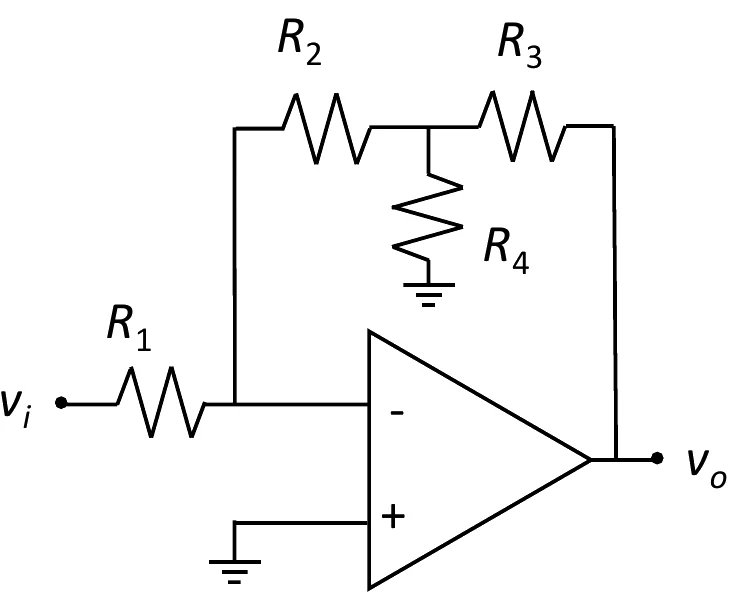
An inverting amplifier has at the input and a T network as feedback: from the inverting input to a node, from that node to ground and from it to the output. All four are 50 kΩ. Find the magnitude of the closed-loop gain.
Answer format: A number (the magnitude), rounded off to two decimal places
Full question on page 57 of the official paper (PDF)
Show answerHide answer
Key idea: Find the T's middle-node voltage from the virtual ground, then apply KCL there.
Official answer: 2.90 to 3.10
The inverting input is a virtual ground, so v_i/R_1 flows through R_2 to the T's middle node M:
V_M = -\frac{R_2}{R_1}v_i = -v_iKCL at M: v_i/R_1 arrives through R_2, and R_4 draws V_M/R_4 = -v_i/R_4 (it pushes current in). Both flow on through R_3:
In general the gain is -\tfrac{R_2 + R_3 + R_2R_3/R_4}{R_1}, here -3. The magnitude is 3.00.
Learn the idea:
Q.63
Communications2 marksNAT
A (7, 4) Hamming decoder that corrects one error sees an average bit error rate of 0.10. Find the probability that it decodes a received word wrongly.
Answer format: A probability, rounded off to two decimal places
Full question on page 58 of the official paper (PDF)
Show answerHide answer
Key idea: It fails only when two or more of the seven bits are wrong.
Official answer: 0.10 to 0.20
Subtract the chance of zero or one error in 7 bits from 1:
Learn the idea:
Q.64
Electronic Devices2 marksNAT
Electron concentration falls linearly from cm⁻³ at µm to cm⁻³ at µm. With cm²/V s, mV and C, find the electron diffusion current density.
Answer format: A/mm², rounded off to two decimal places (the key accepts either sign)
Full question on page 58 of the official paper (PDF)
Show answerHide answer
Key idea: J_n = qD_n\,dn/dx, with D_n = \mu_n V_T from Einstein's relation.
Official answer: -36.50 to -34.50, or 34.50 to 36.50
Einstein's relation gives the diffusion coefficient:
The gradient, over 3\ \mum = 3 \times 10^{-4} cm:
Electrons diffuse towards +x, so the conventional current flows towards -x. Its magnitude is about 35.47 A/mm².
Note: The official key accepts either sign: -36.50 to -34.50 or 34.50 to 36.50. The question asks for the current density without fixing a positive direction.
Learn the idea:
Q.65
Analog Circuits2 marksNAT
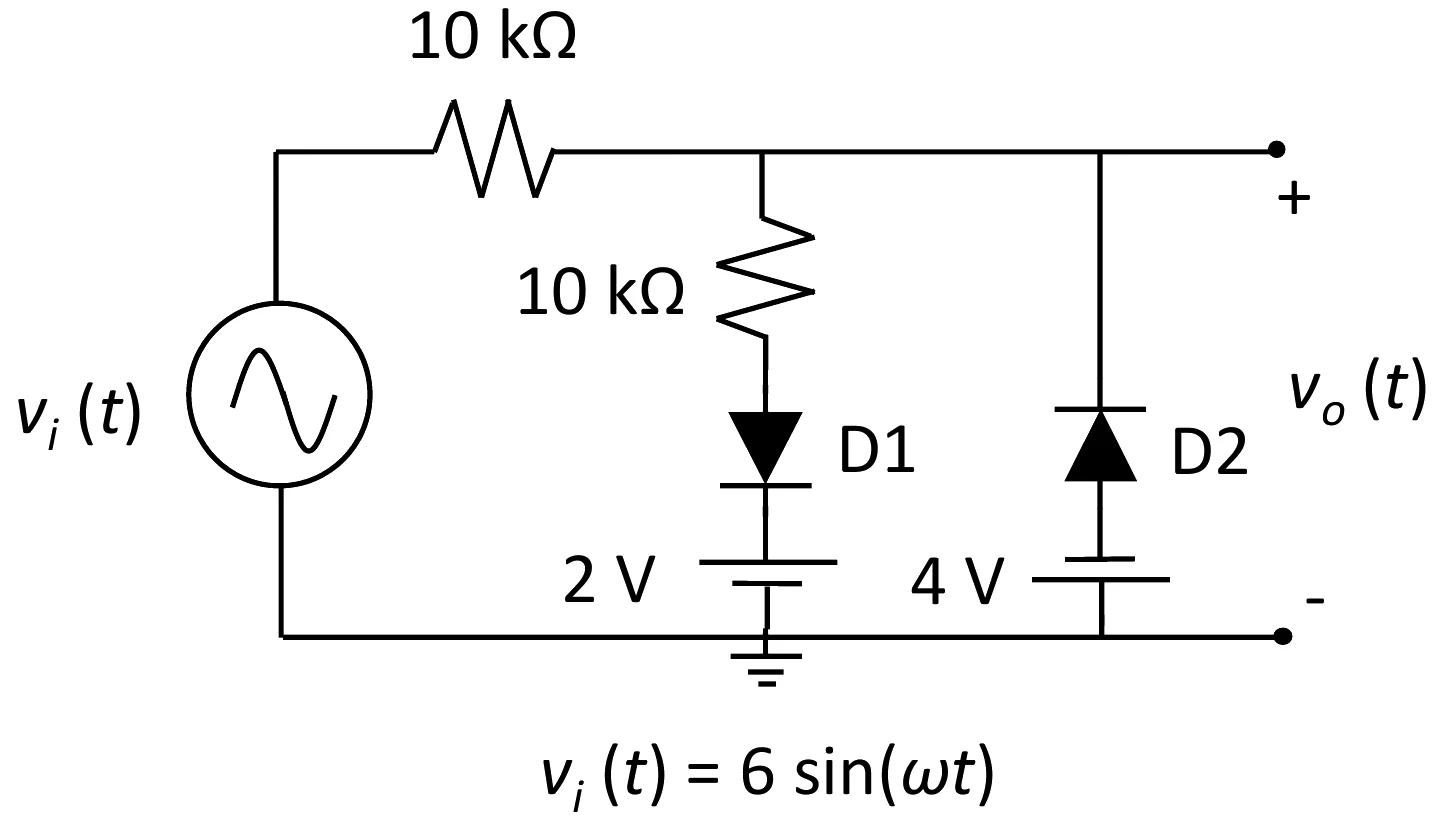
V drives a 10 kΩ series resistor. At the output, one branch is 10 kΩ and an ideal diode D1 to a +2 V battery; the other is an ideal diode D2 from a V battery. Find the maximum output voltage.
Answer format: Volts, rounded off to two decimal places
Full question on page 58 of the official paper (PDF)
Show answerHide answer
Key idea: On the positive peak D1 conducts and the two 10 kΩ resistors divide between the input and +2 V.
Official answer: 3.70 to 4.30
With no load, the output equals v_i until a diode turns on.
- D1 (anode towards the output, cathode on the +2 V battery) turns on when v_o > 2 V.
- D2 (cathode on the output, anode on the battery's negative side, at -4 V) turns on when v_o < -4 V, so it only clips the negative half.
On the positive peak D1 conducts, and the two 10 kΩ resistors divide between v_i and 2 V:
Learn the idea:
Sources
- GATE 2026 EC question paper (PDF), published by IIT Guwahati. The questions are theirs: we paraphrase each question and its options, and link to the original.
- GATE 2026 EC answer key (PDF). It was published after the challenge window closed. The provisional key is no longer available, so we can't tell which answers, if any, changed between the two. The key awards no marks to all.